Stacked Farm Plans California Vertical Farm for 2028 After Las Vegas Test Center Opens
Climate Science Jennifer Marston 787 reads
Stacked Farm plans a California facility for 2028, using a Las Vegas center to test crops, operations and customer demand before scaling.
Stacked Farm’s planned US expansion puts customer readiness and operating performance ahead of rapid construction. The Australian company plans to open a large vertical farm in Southern California in 2028, while a Las Vegas research and customer experience center is already operating to test products and prepare for commercial supply.
The sequence reflects the company’s approach to a sector where several US vertical farming businesses have closed or sharply reduced operations after years of difficulty. Founder and CEO Daniel Tzvetkoff says Stacked Farm spent years refining its model in Australia before pursuing expansion. The company was founded in 2016.
“You’ve got to scale up in steps, and you’ve got to make sure everything works before you start to build these large-scale facilities,” Tzvetkoff says. He describes the company’s early years as a deliberate effort to prove its systems before committing to larger sites. That approach shapes both the planned California farm and the Las Vegas facility now supporting its US entry.
Replicating an Australian operating model
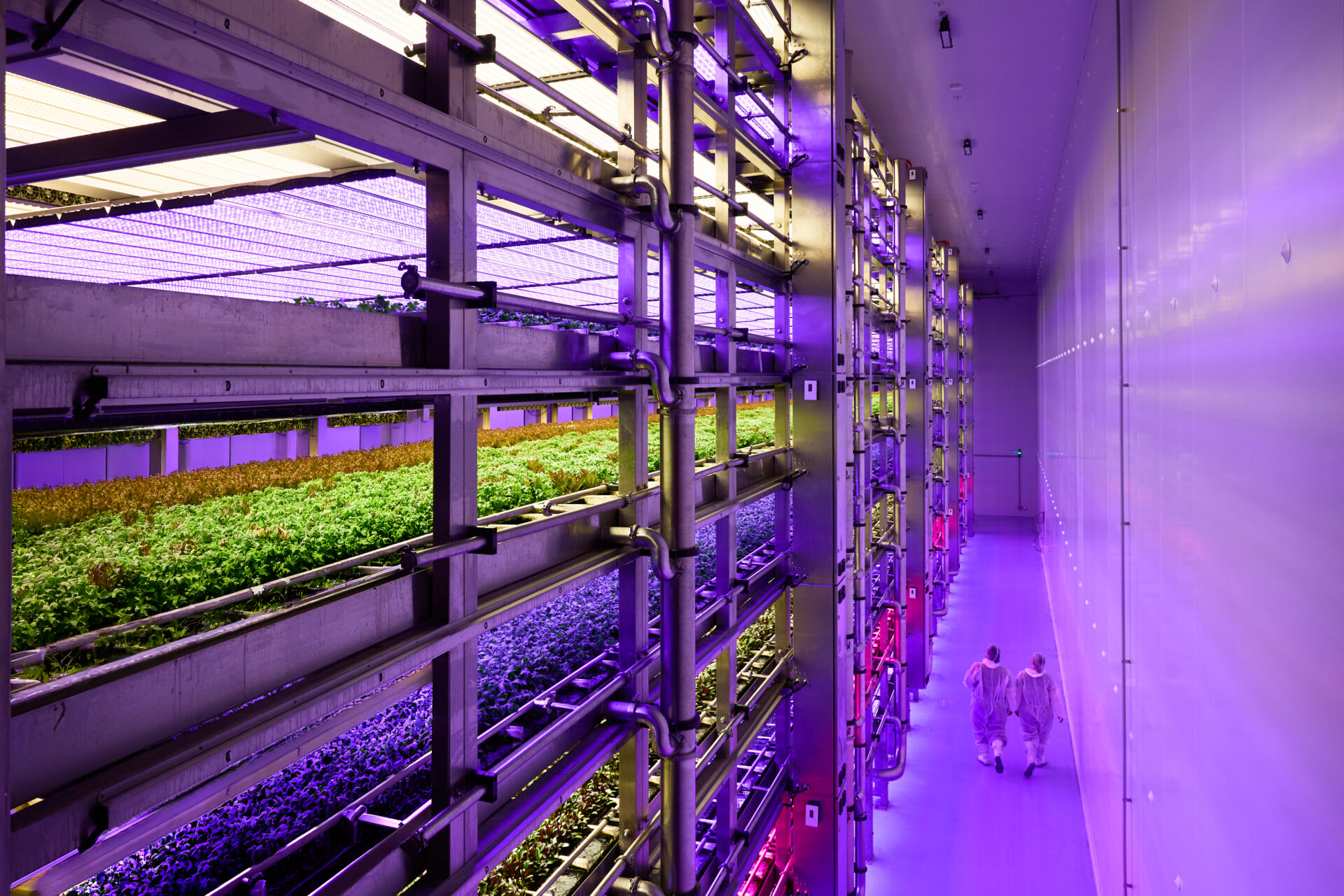
Stacked Farm intends to reproduce its existing Australian facility in California, carrying over crop recipes, operating systems, production methods and automation. Tzvetkoff says the company chose to establish its model in Australia because the country’s high labor and energy costs place pressure on farm economics. Its aim was to demonstrate that the operation could work in that setting before taking it to other markets.
The company designs and builds its facilities and develops its growing technology in-house, including lighting, automation and cultivation methods. It owns and operates its farms rather than building facilities for other businesses. Tzvetkoff says bringing plant scientists and engineers together within the company helps the team address production challenges as a connected system.
Energy use is one such challenge. Indoor farms rely on lighting to support crop growth, while cooling and dehumidification manage heat and moisture inside the growing environment. Stacked Farm says its own lights produce less heat than the off-the-shelf alternatives it has assessed. If that reduces the cooling and dehumidification load, the facility may need less HVAC capacity. The company says it has spent much of the past decade refining this relationship between lighting and climate control.
That systems approach matters because lower heat output alone does not establish a farm’s overall energy performance. Lighting, cooling, dehumidification and automation all contribute to operating needs, alongside labor and the costs of producing and delivering crops. The planned California facility will put the Australian configuration into a new market; performance there will show how well the model transfers under different operating conditions.
California is Stacked Farm’s first US location because of the state’s importance in lettuce and herb production. The company plans to open two US facilities a year and is working to secure land in Georgia, Pennsylvania and Texas. Those sites remain part of its expansion plans, while the Southern California farm is scheduled to open in 2028.
Testing products and demand before the farm opens
The Las Vegas research and customer experience center opened earlier this month and follows the company’s Australian model. Its role is to reduce operational and commercial uncertainty before the much larger California facility begins production. Customers can assess products in advance, while the company can work on product specifications and operating details before it needs to deliver at scale.
Tzvetkoff says a large farm needs a sales pipeline in place before production starts. In his view, operators risk a mismatch if they build substantial capacity on the assumption that buyers will arrive later, or wait until a facility is open to seek customer approval. Stacked Farm says the Las Vegas center is intended to put product sign-off ahead of the California farm’s opening.
The company has had a US sales team on the ground for nearly three years. It also has long-term supply agreements with Great West Produce in California and Lagudi Fresh Food Group in Nevada, along with retail distributor Mana Foods. These relationships give the company a route to discuss products and supply ahead of the planned facility’s start-up.
For buyers, early product testing can clarify whether crops meet their requirements before a new source of supply is ready. For the operator, customer feedback can inform production planning and help align output with expected orders. Those steps do not remove the risks of building and running a large indoor farm, but they can make demand and product acceptance part of the preparation process rather than assumptions made after construction.
Stacked Farm’s US expansion now has two milestones to watch: how the Las Vegas center prepares products and customers for supply, and whether the California facility can reproduce the Australian operation at commercial scale. Its planned pace of two US openings a year will depend on turning that preparation into farms that can meet customer needs while managing energy, cooling and production costs.