Salt-Tolerant Wheat Edges Toward 2027 With Fresh Seed Funding
Climate Science Elaine Watson 455 reads
OlsAro's €5m seed round will fund salt-tolerant wheat work ahead of a 2027 launch, with trials running from Bangladesh and India to Kenya and Pakistan.
Wheat has been the gap in salt-tolerance research for a while. Rice has drawn most of the attention, and that's what makes OlsAro's latest move worth a closer look. The Swedish startup has raised a €5 million ($5.5 million) seed round to build out its SeedAX platform as it prepares for commercial launch in 2027. Industrifonden and Nordic Foodtech VC co-led the round, with support from Future Food Fund, PINC, AgFunder and GU Ventures. Cumulative funding now stands at €7.5 million ($8.3 million).
The money is earmarked for three things: accelerating commercial work, funding new programs on drought tolerance and nitrogen-use efficiency, and extending the platform into other cereals, rice included. Industrifonden's Sara Frykstrand Ångström pointed to the science behind the company and its field-trial results as the deciding factors. "With SeedAX, OlsAro has the opportunity to turn this into a scalable platform for seed companies looking to develop climate-resilient varieties across multiple traits and markets," she said.
Why saline soil is eating into cropland
Salinity affects roughly a tenth of the world's cropland, and it's getting worse in places where farmers can least afford it. Flooding and cyclones push salt into soils, but the bigger driver in many regions is irrigation with saline or brackish water, which is often the only water available when freshwater runs short. Meanwhile, heat and drought are squeezing cereal production from the other side. Put those pressures together and the case for varieties that hold yield under stress gets much easier to make.
CEO Elén Faxö put the problem in terms of land lost rather than yield lost. "We're seeing a steady reduction in the amount of cultivatable land due to soil salinity, which can mean lower yields or at worst no growth at all," she said. Her framing is that OlsAro wants to enable farming on land that's otherwise unfarmable, and the company claims its wheat can deliver meaningful yield gains over elite local varieties in saline soil.
Field results and the markets being tested
The headline number is a yield increase of up to 41% over a moderately salt-tolerant variety under saline conditions in Bangladesh. That's a single-region result from a company-run trial program, so it's best read as a strong early signal rather than a settled benchmark. Still, it's the kind of data seed companies tend to ask for before committing breeding budgets.
Bangladesh is the lead market. OlsAro is working with Lal Teer Seed, which describes itself as the largest private biotech and seed company in the country, toward a 2027 commercial launch. Faxö noted that around one million hectares there are affected by salinity while demand for locally grown wheat keeps climbing.
Beyond Bangladesh, the company is running salt- and heat-tolerance trials in Kenya, Pakistan, Egypt, Italy, Canada and Australia. Kenya and Pakistan are at the advanced stage, according to Faxö. She also argued that because the commercial varieties are developed without genetic modification, they can enter these markets without GM regulatory hurdles. That's a claim worth tracking, since how individual countries classify edited and mutagenized crops varies, and a company's own framing won't settle that question.
India is the other major focus. OlsAro has been working with DCM Shriram, which the company describes as the largest player in proprietary wheat seeds in the country. DCM Shriram has trialed OlsAro's salt-tolerant lines in Uttar Pradesh and Bihar. Faxö pointed to close to seven million hectares of salt-affected soil in India, adding that rising heat makes the case for resilient wheat stronger each season.
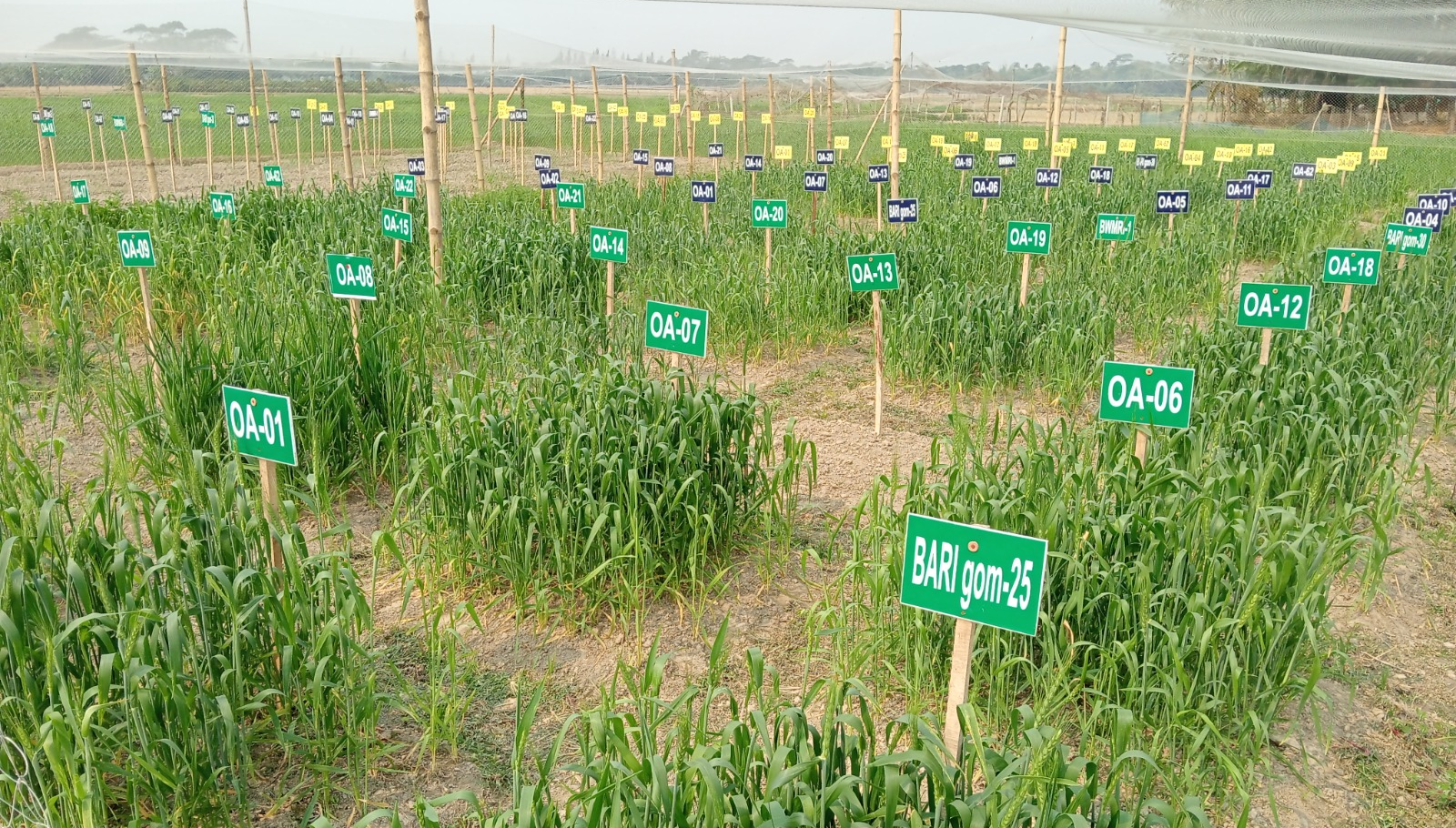
The company says its varieties are designed to beat conventional wheat across a band of salinity from 4 to 8 deciSiemens per meter (dS/m), and up to 10 dS/m. Faxö framed that range as moderately to strongly saline soil, which is where conventional wheat starts losing a lot of yield and where a large share of salt-affected farmland sits. In her words, even moderate gains there can bring land back into production. For a farm that's been written off, that's the difference between a loss and a crop.
Two routes depending on the rules
OlsAro is pursuing two development paths, and the choice between them depends on the rules in each target market. The first is a population-based approach using EMS mutagenesis. The seeds are treated with a chemical agent to introduce high genetic diversity, and the team then screens those populations for desired traits. Faxö says the advantage is that this approach is non-GM globally, so the company can target any market without triggering GM classification.
The second path is gene editing. Here the company uses AI to narrow down single nucleotide polymorphisms linked to its target traits, then either integrates those traits into local elite varieties through editing or through the population-based method. Faxö said the AI runs on a combination of proprietary data and open-source data, including genomic, field and transcriptomic information.
Her description of the population work is worth noting for anyone evaluating breeding pipelines. It runs in both directions. Phenotypic screening looks for physical traits within the populations, while genotypic screening works from DNA markers that the AI has flagged. That combination is a sensible way to shorten the time between identifying a trait and putting it in a variety, though the proof will come in how those varieties perform across soils the company hasn't yet tested at scale.
What to watch before 2027
The 2027 launch in Bangladesh is the first real test. A commercial release will show whether the trial yields hold up when farmers plant the seed on their own fields, under their own irrigation and management. The more interesting question is whether seed companies adopt OlsAro's platform for their own breeding programs, because that's the model the company is building toward. If the platform works, the value sits less in any single variety and more in the trait-discovery engine behind it.
And yet the hardest part may be the least glamorous one: getting seed into the hands of farmers on saline ground at a price they can justify. That's where the next round of data, from more markets and more soil types, will matter most.