Landscape-Scale Regenerative Agriculture Focuses on Local Challenges and Long-Term Results
Climate Science Stephen Wood and Steve Rosenzweig 927 reads
Regenerative agriculture can deliver lasting gains when strategies address each landscape’s defining challenge and adapt as evidence grows.

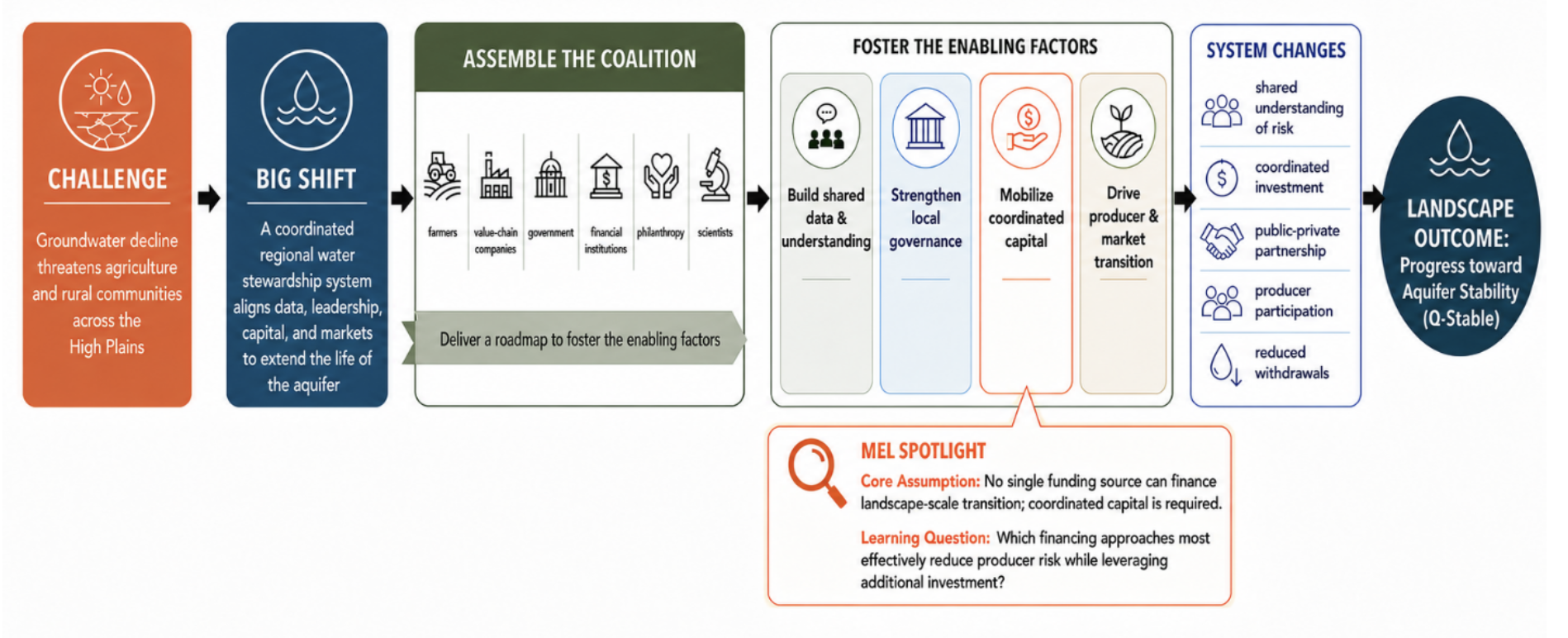
Regenerative agriculture targets are often counted in acres, but acreage alone can’t show whether farming is addressing a landscape’s most pressing environmental challenge. In western Kansas, where groundwater decline threatens agriculture and rural communities, that challenge is pressure on the Ogallala Aquifer. The practical question is how farm practices, markets, financing and coordination can combine to ease that pressure over time.
More than 100 major companies have committed to advancing regenerative agriculture across millions of acres by 2030. Those commitments provide a direction for action, but the measures needed to create durable environmental gains vary by place. In the Upper Midwest, for example, nutrient runoff is degrading water quality. Groundwater depletion, land use change and soil degradation each arise from different combinations of ecological and economic forces, so a uniform package of practices may miss what matters locally.
The Nature Conservancy (TNC) and General Mills have worked together to adapt TNC’s monitoring, evaluation and learning approach to General Mills’ regenerative agriculture strategy. Their work points to a broader method: define the central challenge in a landscape, state how proposed actions are expected to address it, then use evidence from implementation to adjust the strategy.
Start with the place’s defining challenge
Regenerative agriculture can support soil health, improve water outcomes, benefit biodiversity and strengthen farm economics. That breadth is valuable, but it can make a program harder to steer if every possible benefit is treated as equally important. Teams may then lack a clear basis for deciding what to measure or what success should mean.
Programs can also lose relevance when they prescribe one set of practices or prioritize a single benefit without reflecting the needs of the people whose participation is necessary for change. A landscape-scale strategy offers a way to focus effort: stakeholders identify the challenge that best captures the place’s pressing needs and use it to align farm-level changes with wider shifts in the surrounding system.
For western Kansas, the aim is not simply to expand regenerative practices. It is to reduce pressure on the Ogallala Aquifer over time. That framing makes clear why progress depends on more than individual farms or one company’s sourcing region. It calls for coordination across the conditions that shape farmers’ choices and the region’s water use.
Test the assumptions behind the plan
Once a defining challenge is established, a learning-centered strategy sets out a theory of change: a clear explanation of how particular actions are expected to produce change in that landscape. It makes the assumptions behind the plan visible and testable, so teams can revise their approach based on what happens in practice.
In western Kansas, evaluation can ask whether farmers can access trusted groundwater information and whether it affects their decisions. It can test whether financing reduces producers’ risk, whether market signals support lower-water production systems, and which combinations of technical support, capital and coordination help practices last. These questions examine the conditions that allow conservation efforts to grow beyond isolated demonstrations.
That distinction matters because activities alone don’t establish that a landscape is changing. Enrolling acres or recording a conservation practice says what was done. A learning process investigates whether the plan’s assumptions are holding up, what is helping or hindering adoption, and which adjustments could improve the chance of a lasting result. Over time, those findings can help organizations refine strategies and strengthen collaboration.
Pair outcome tracking with learning
Outcome metrics support accountability and transparency. Company measures and shared frameworks such as the Science Based Targets initiative can track reported progress. But outcome tracking by itself may not reveal whether an organization’s work is addressing a landscape’s central challenge.
Many company reporting frameworks focus on results at the level of a single business, while agricultural pressures cross company boundaries and are experienced across whole landscapes. A company-level measure may therefore provide limited insight into whether partners are working effectively on a shared local problem. And results in agriculture can shift with natural variability, market conditions and other influences beyond one intervention. A metric can record what changed without explaining why, or what to adjust next.
Learning complements outcome tracking by helping teams interpret those results and test how their strategy contributed. That capacity requires time, partnerships and evaluation systems that connect local evidence with decisions. It can help organizations distinguish a change associated with their activities from a result shaped by other conditions, while keeping the focus on improvements that can endure.
Build the capacity to adapt
As regenerative agriculture reaches more farms, its next phase will depend on understanding how change unfolds in different places. For companies, that means pairing sustainability targets with investment in the systems and relationships needed to learn what works, where it works and why.
The TNC and General Mills collaboration shows how monitoring, evaluation and learning can be applied to a company’s regenerative agriculture work. The wider lesson is that ambitious targets should account for the needs of the landscapes where they are pursued. The number of acres covered remains useful, but its meaning depends on whether the work responds to local challenges and whether evidence guides changes along the way.
For companies sourcing agricultural ingredients, a practical next step is to build the capacity to learn and coordinate with others in the landscapes they depend on. That makes regenerative agriculture a continuing effort to adapt practices and partnerships to local conditions, with progress judged by both measured outcomes and the evidence that helps sustain them.