Four Futures for Agricultural Biologicals: Performance and Scale Will Shape Growth
Climate Science Gustavo Mamao 955 reads
Biologicals’ next phase depends on consistent field performance and fit with manufacturing and distribution. Four scenarios show where companies may need to adapt.

Agricultural biologicals are gaining ground, but their next phase will depend on two tests: whether new technologies deliver reliable results in the field, and whether companies can manufacture and distribute them at scale. For businesses in the sector, growth alone won’t settle where to invest. The sharper question is which products can create durable value in an industry where many established biological inputs face price pressure.
The category has moved from the edges of agriculture into wider use in some crops and regions, with double-digit growth reported by DunhamTrimmer. Yet biological products can be less stable than synthetic chemical inputs. Their activity may decline between production and application if handling and storage aren’t suited to the product. Field results can also vary depending on how a biological fits into crop and pest management practices.
That variability makes it harder to prove efficacy, deliver expected yield benefits and build grower confidence. At the same time, products without clear differentiation can be produced by dozens or even hundreds of suppliers. When buyers see few distinctions, relationships and price weigh heavily in purchasing decisions. This dynamic has contributed to falling prices in some commoditized categories.
New platforms—including metabolites, proteins, peptides, genetically modified microorganisms and RNA interference (RNAi) solutions—could change the equation. Their potential advantages include more consistent performance, targeted modes of action and easier integration into existing input systems. Some may also fit current manufacturing, formulation, logistics and distribution networks. Those possibilities remain to be demonstrated across products and uses.
Two uncertainties, four possible paths
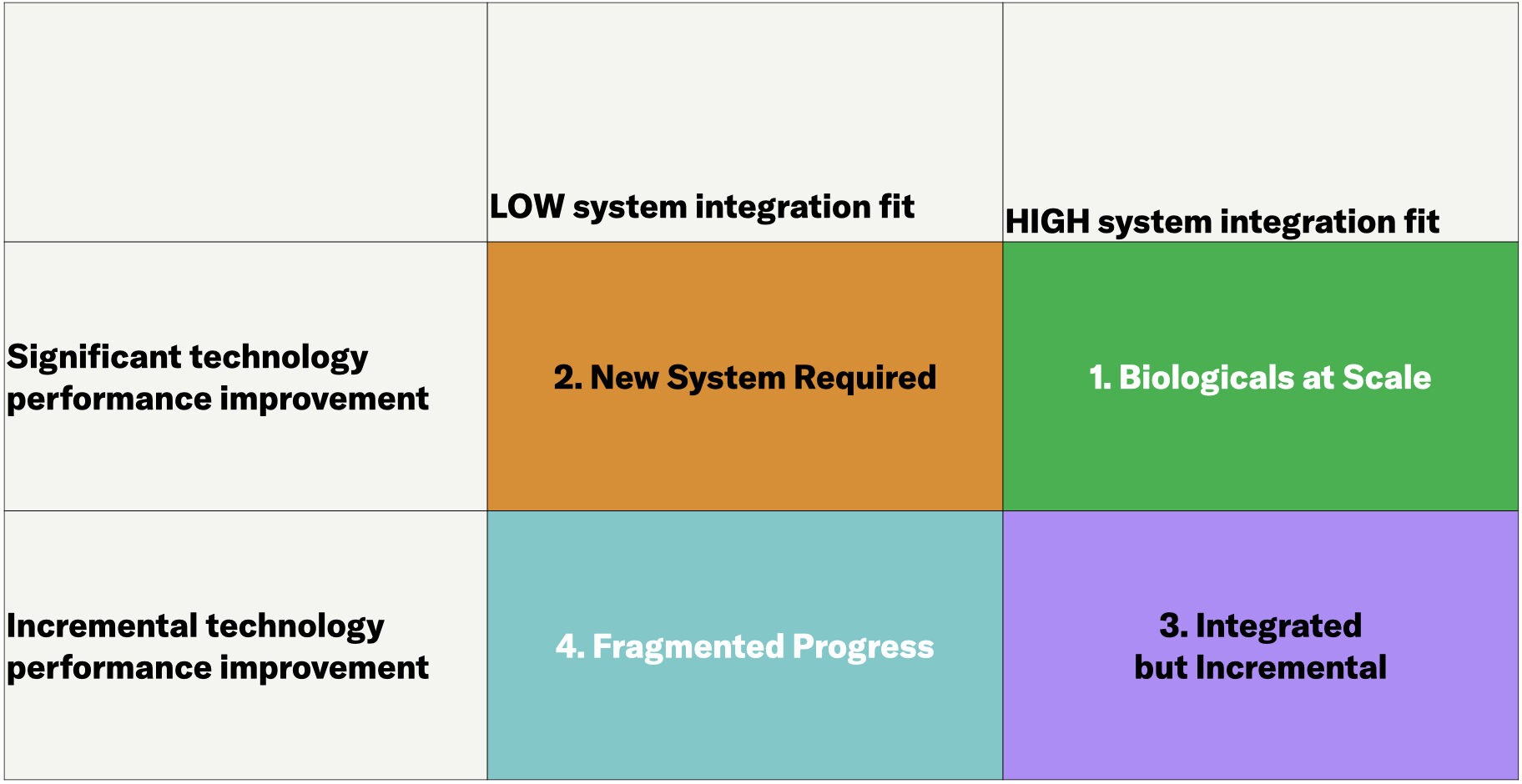
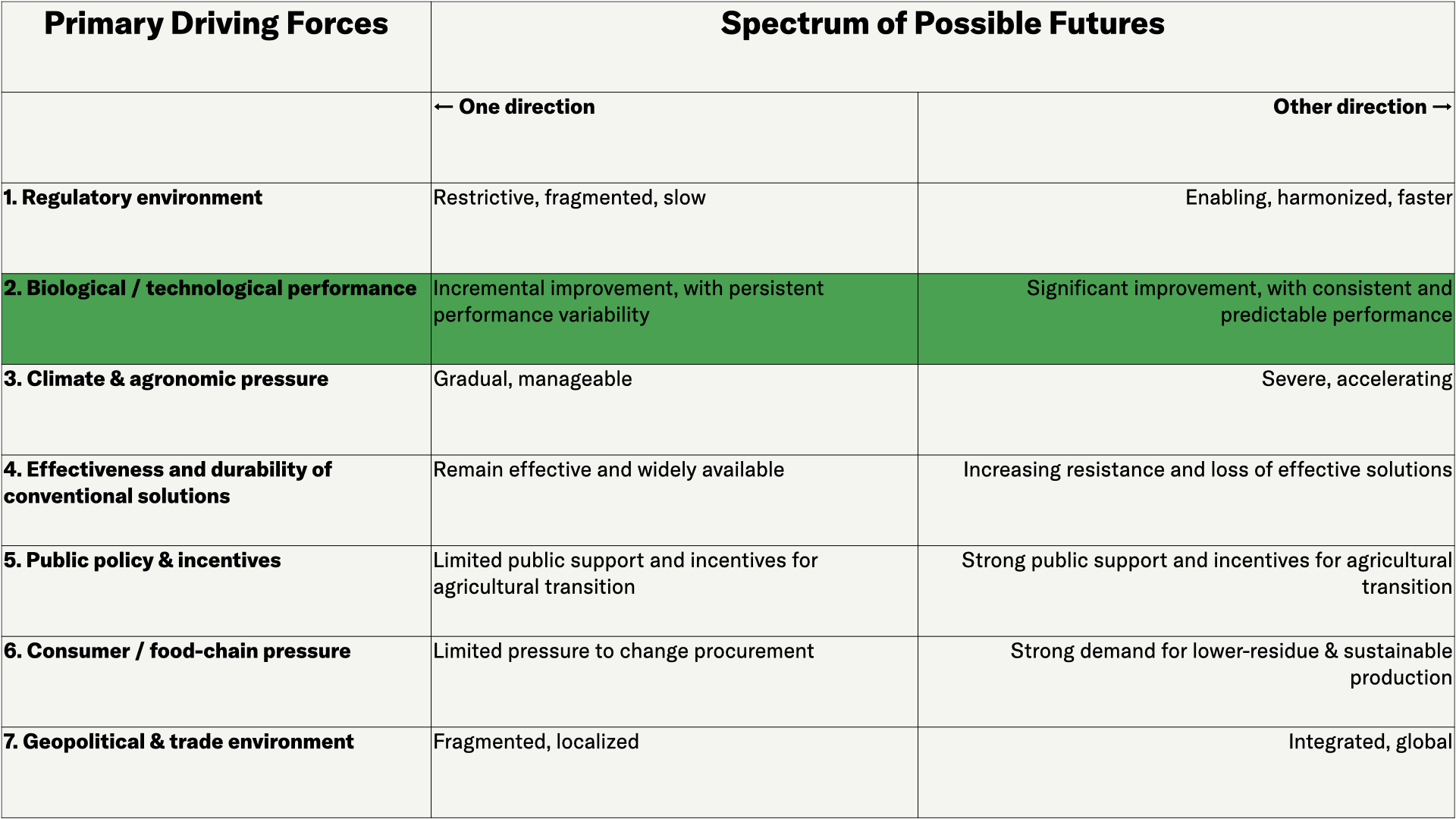
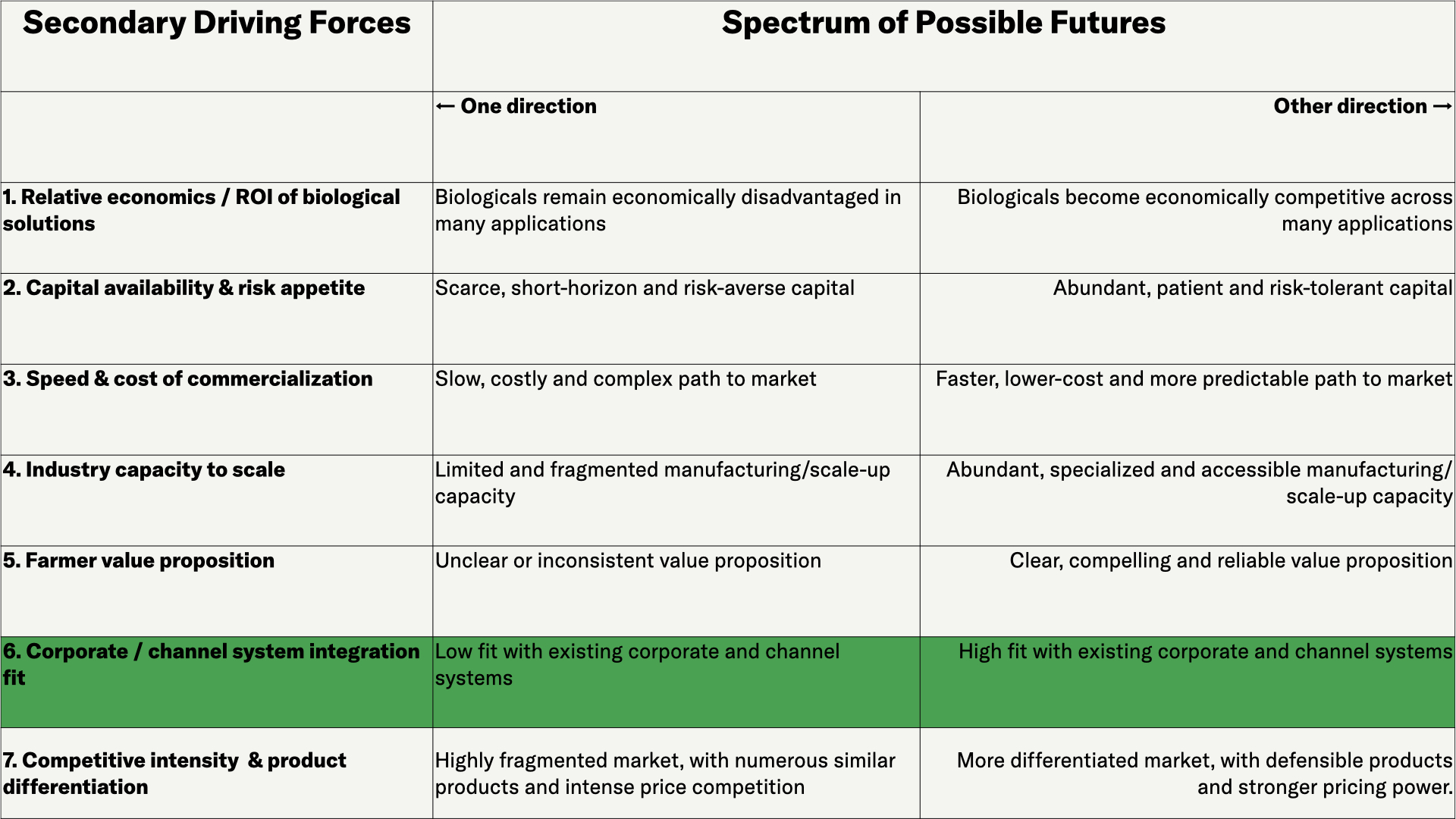
A 10-year scenario exercise frames the industry’s choices around two forces with high potential impact and uncertain outcomes. The first is technological performance: whether emerging platforms can improve efficacy, consistency and predictability. The second is fit with existing business systems: how readily input companies can manufacture, distribute and apply those products through established channels.
Combining high or incremental progress on both fronts produces four plausible futures. These aren’t forecasts. Their value is in helping companies identify decisions that may hold across different outcomes, and signals that could indicate which path is taking shape.
When performance and integration both improve
In the most favorable scenario, new biologicals deliver a clear step forward in efficacy and consistency, while fitting existing manufacturing and distribution systems. Grower confidence rises, and large input companies can bring differentiated products to market using capabilities they already have.
Commoditized products would still face price competition, but higher-performing technologies could open new sources of value. Biologicals would become a more established part of crop protection and nutrition portfolios. Companies that pair meaningful product differentiation with market reach would be positioned to expand faster.
That outcome depends on both parts working together. Strong lab or product results alone won’t generate broad adoption if products are difficult to produce, handle or apply. Likewise, an efficient channel can’t compensate for inconsistent field performance.
When technology outpaces the system
A second scenario assumes that new platforms improve product performance, but don’t fit neatly into existing processes. Manufacturing requirements, formulation needs, distribution arrangements or application practices could become bottlenecks. The products may work, yet take longer and cost more to scale.
In this future, established biological categories continue toward commoditization as differentiated technologies create separate pools of value. Specialized manufacturers, formulation businesses, technology partners and new commercial models could serve as connectors between product developers and the agricultural market. Their role would be to address practical barriers that established systems aren’t set up to handle.
The distinction matters for businesses assessing a promising platform: the route from efficacy to widespread use may require partners with specific production or delivery skills, rather than simply adding the product to an existing catalogue.
When integration advances faster than efficacy
In a more incremental future, biological products improve steadily, but performance remains variable in some applications. Meanwhile, established companies get better at incorporating biologicals into their manufacturing and distribution systems.
With fewer barriers to moving products through the market, competition could shift toward price, brand, distribution strength and bundled offerings. Biologicals would increasingly complement conventional inputs within broader crop-management programs. Companies with wide portfolios and established grower relationships could gain ground, while a biological business relying on one product’s novelty might find differentiation harder to sustain.
For growers, the practical value would depend on how well products work as part of an overall program, not only on their standalone claims. Education about modes of action and use alongside other tools would remain important.
When progress stays fragmented
The fourth scenario combines incremental performance gains with a poor fit between new products and existing systems. Biologicals continue to show promise, but inconsistent results limit changes in the value they offer growers. Manufacturing, distribution and application challenges keep commercialization complex and costly.
Established products would still face price pressure, while newer technologies could struggle to build markets large enough to scale. Some businesses and products might succeed in particular crops, regions or farming problems, but the broader input sector would remain a patchwork of opportunities rather than a substantially transformed market.
What the scenarios mean for companies
For established input companies, integration is a potential advantage. Products with stability, shelf life and application requirements that work within current operations could move through existing systems more readily. But distribution reach can’t replace a clear product case: growers still need to understand how biologicals work and how to use them within integrated crop and pest management.
Specialist biological businesses bring capabilities that larger companies may lack, including fermentation capacity and sales teams experienced with a diverse set of products. Some have already reached more than $20 million in revenue. Their challenge is to keep creating differentiated products rather than competing mainly in categories where suppliers can undercut one another.
Startups face a harder proof point: showing that new platforms deliver better performance while capital is scarcer and competition is intense. They can also consider how their products might connect with established companies or specialist manufacturers. For example, protein- and peptide-based technologies may use outside fermentation capacity to reach competitive production costs.
For each group, the route to market will depend on the technology and the capabilities it needs. “Integration” can mean different things across manufacturing, formulation, sales and field use, so companies need to assess their own gaps rather than assume a single model applies.
Signals to watch over the next decade
Companies can make scenario planning practical by tracking early evidence. Useful indicators include the pace of commoditization across product lines, the range of technologies in startup development pipelines, production scale and economics, and field validation as performance data becomes available. These signals can help teams revisit investment priorities as evidence changes.
There’s also a question for established companies about execution. The presence of specialist businesses in the $200 million to $500 million range suggests that large firms haven’t fully used their infrastructure to expand biologicals. Acquisitions haven’t always translated into a sustained focus on the distinct needs of biological products, and new entrants continue to compete directly.
Agricultural input markets tend to adopt change over several years. That creates a meaningful gap between making a move and seeing its expected results. Companies that use that time to validate performance, solve scale-up needs and match products to the right channels will be better prepared across all four futures. The key evidence to watch is whether biologicals become reliably useful in the field and straightforward enough to deliver at scale.