Liberation Bioindustries Seeks $25 Million to Complete Indiana Fermentation Plant
Climate Science Elaine Watson 318 reads
The Richmond facility is largely built, but Liberation needs $25 million and firm customer commitments to bring its 600,000-liter plant online.
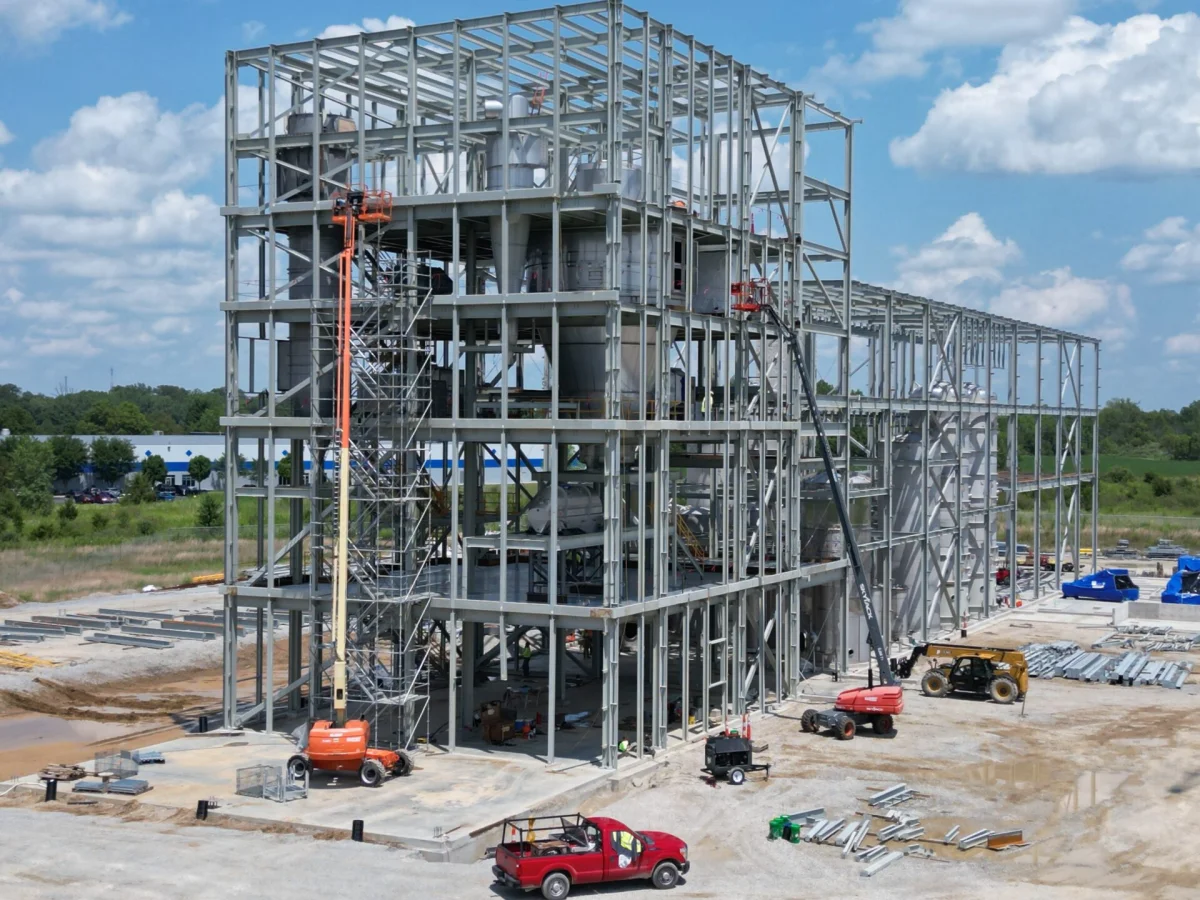
Liberation Bioindustries has a largely built fermentation plant in Richmond, Indiana, but needs another $25 million to finish it. The funding gap puts a practical question at the center of the company’s plans: can a shared, large-scale facility attract customers ready to sign long-term supply agreements before it is operating?
Agronomics, a key shareholder, said a four-month review of a possible sale or joint venture produced “no acceptable offers.” Liberation now plans to complete the site without an external partner. Agronomics and other institutional shareholders are working on a financing package, which could combine additional shareholder equity, secured debt, grants and loans from public authorities, and customer prepayments.
What remains to be built
The 600,000-liter facility was originally expected to begin operating by the end of 2024. Construction is paused while the company seeks the additional $25 million, on top of $125 million already deployed through equity, debt, and other support.
Agronomics said the earlier financing plan assumed that all expected funds would arrive. Some did not. Project delays, exceptional costs, and increases tied to global economic conditions added to the shortfall. The company is working toward a complete funding package in the first half of 2027, though timing remains uncertain.
If the money is secured, Agronomics estimates the plant could be running within six months. Major construction elements are complete; the remaining work is largely piping, welding, and electrical installation. The facility was designed with four 150,000-liter fermenters in two independent operating trains. Each 300,000-liter train has its own downstream processing equipment and is intended to handle organisms producing proteins, sweeteners, colors, and other ingredients.
Interest does not equal contracted demand
The case for the Richmond site rests on a gap in contract manufacturing. Liberation cofounder Mark Warner argued in 2023 that existing biopharmaceutical facilities were poorly suited to food-grade production, while early-stage companies often struggled to finance their own industrial-scale equipment. A dedicated facility could give those firms access to larger production runs without requiring each one to build a plant.
But the sector’s need for manufacturing capacity does not automatically translate into bankable demand. One precision fermentation founder said many startups may express interest but are not ready to commit to multi-million-dollar annual contracts. The Richmond plant is large, and relatively few companies are prepared to book fermentation capacity at that scale for continuous production.
Customers also face operational and technical uncertainty. A new facility brings unfamiliar equipment and an untested operating team, alongside the process scale-up risks that startups already have to manage. The site may lower production costs compared with smaller operations, but it may not deliver the maximum economies of scale. And because it serves multiple customers, its downstream processing equipment cannot be fully tailored to every product.
A veteran manufacturing source said the plant can add or remove downstream processing steps, a kind of customization that contract manufacturers often need to make. The harder question is whether enough potential customers are far enough along to sign multi-year agreements. In this field, that typically means having a sufficiently advanced product and a credible route to sales, such as a conditional purchase order or another supply contract.
Bringing a new food ingredient to market has proved harder than many startups expected, the source added. He pointed to the inventory of GRAS notices as one way to gauge which companies may soon need production capacity. In his assessment, many relevant pending notices were filed by companies outside North America or by larger firms with their own fermentation assets. He identified notices 1319 and 1322 as possible fits for Liberation, while cautioning that the pool of likely customers had narrowed.
Scale, competition, and financing
The facility occupies a middle ground. One industry source described it as too large for some startups but too small to capture the full cost advantage available at much larger scale. Another expert focused on purified food proteins said the Richmond plant might not serve the total demand expected for many products, yet could still work as a company’s first factory. A startup could use it to launch production and build a customer base before expanding elsewhere.
That makes the first customer especially important. Reaching the lowest possible unit cost can come later; an initial supply agreement may be what allows a product to enter the market. The financing challenge is that customers want confidence about when the plant will open before making binding commitments, while funders want firmer customer commitments before releasing more money. Liberation’s chief executive, Etan Bendheim, described this as a “chicken and egg” problem.
Bendheim said over the summer that customers had expressed qualified interest equivalent to more than 200% of the site’s available capacity. He argued that competition from newer facilities in China, India, and Europe was not what held Liberation back. A manufacturing source said some Indian capacity might offer more competitive economics, while also carrying operating risks for startups located far away.
Financing conditions may be another constraint. One precision fermentation expert said investor attention has shifted strongly toward artificial intelligence and that interest rates remain high. Another industry source attributed the company’s difficulty to a tough fundraising environment and said the sector needs more commercial successes.
The Richmond project therefore tests more than whether construction can be completed. Its progress will show whether early interest can turn into contracts that support a shared plant, and whether financing can bridge the period before customers have confidence in its operating schedule. Agronomics says it and Liberation remain committed to finishing the site. The next concrete marker is whether they can assemble the funding package targeted for the first half of 2027.