IMIO Raises $12 Million to Scale Crop Residue Nutrient Recovery
Climate Science Elaine Watson 420 reads
IMIO’s $12 million seed round will expand production of microbial treatments that break down crop residues, with field trials reporting higher corn yields.
Crop residues can hold nutrients farmers would otherwise need to replace with fertilizer. IMIO is developing microbial treatments to make those nutrients available to the next crop, and a new $12 million seed round will help the company expand production and build a biomanufacturing and research facility in Chicago.
The round brings IMIO’s total funding to $16.5 million. Sofinnova Partners led it, with participation from Chipotle’s Cultivate Next venture fund, Starshot Capital, Grow Together Salinas, Earth Foundry and Serra Ventures. The company plans to use the funding to grow its team and production capacity.
Putting crop residues to work
Founded in Vermont in 2019, IMIO initially explored recovering value from organic material headed for composting. The company shifted its focus after finding that many compost facilities operated at a significant loss, founder and CEO Charles Smith said. Farms offered a different opportunity: they produce large volumes of plant matter while spending money on fertilizer for subsequent crops.
Smith estimates that an acre of corn stover contains about $134 worth of nitrogen, phosphorus and potassium. Residues from some specialty crops, including broccoli, can have even greater nutrient value. The challenge is making those nutrients available at the right time and in a form that crops can use.
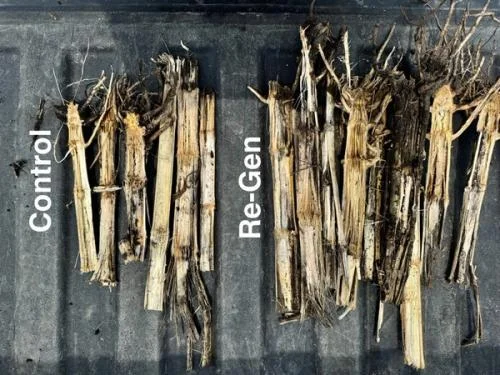
IMIO’s Re-Gen products are applied to residues, rather than relying on microbes to establish themselves in soil and compete with existing microbial communities. The company says this lets the organisms begin breaking down organic matter directly. Re-Gen for Row Crops and Re-Gen for Produce are typically applied in spring, around planting, with the aim of releasing nutrients as the next crop begins growing.
The approach targets a practical timing problem. Residues decompose naturally, but that process may not release nutrients when crops need them. IMIO also points to changes in crop varieties and farming practices: modern corn can have higher lignin content, making its residues harder to break down, while conventional practices can reduce soil fungi that contribute to decomposition.
Keeping microbes viable from production to field
IMIO’s formulations use naturally occurring, non-GM organisms selected for their ability to break down organic matter. The company grows strains separately, freeze-dries them, then blends them in set ratios. Growers receive a powder to mix with water before application.
Freeze-drying, also known as lyophilization, removes water without the heat used in spray-drying. Smith says that gentler process helps preserve the microbes, including some lignin-degrading fungi that would not survive conventional heat-based drying. IMIO says its powder has a shelf life of more than 12 months and that the process supports consistent microbial activity between batches.
Production combines the company’s own expansion in Chicago with fermentation partnerships, including a South Dakota facility equipped with freeze-dryers. Smith said IMIO uses restricted-access controls so partners can run its production protocol without seeing the protocol details. The company describes its formulations as patent pending.
Field results and customer experience
IMIO says university and farm trials across more than 10,000 acres in the Midwest in 2024 and 2025 produced an average corn yield increase of 11.9 bushels per acre. Results ranged from 5 additional bushels to more than 20, depending on residue levels and existing crop management. The company also tracks fertilizer and tillage savings, which can affect the economics of using a treatment alongside yield.
One customer, Kirk Stueve, farms and owns land leased to other growers in Minnesota and Wisconsin. After using Re-Gen for a couple of years in a high-residue, four-year corn-on-corn rotation, a treated 140-acre field exceeded its historic yield record by 36 bushels per acre. Stueve said he reduced nitrogen spending by $45–$50 per acre without sacrificing yield. That is one farm’s reported experience, while the broader trial results show that outcomes vary.
IMIO has about 100 customers and has generated commercial revenue on a small scale for a couple of years. It began by selling directly to farmers and is now starting to work with distributors. Beyond corn, the company is pursuing specialty crops such as broccoli, Brussels sprouts and lettuce, and sees cover crops as another potential source of organic material for treatment. Chipotle has helped connect the company with specialty-crop growers.
Biological products have faced adoption challenges when performance varies from field to field or batch to batch. IMIO argues that applying concentrated microbes directly to residues, combined with its production process, can improve reliability. The next test is whether the company can scale supply while delivering results across crops, farms and growing conditions; for growers, the value will depend on repeatable yield or input savings that justify the treatment.