EU Car CO₂ Standards Could Shape 2035 Jobs Across the Electric Vehicle Supply Chain
Climate Science d.scott 554 reads
An ICCT analysis projects stable employment under current standards, while a five-year delay could leave jobs 185,000 below 2025 levels by 2035.
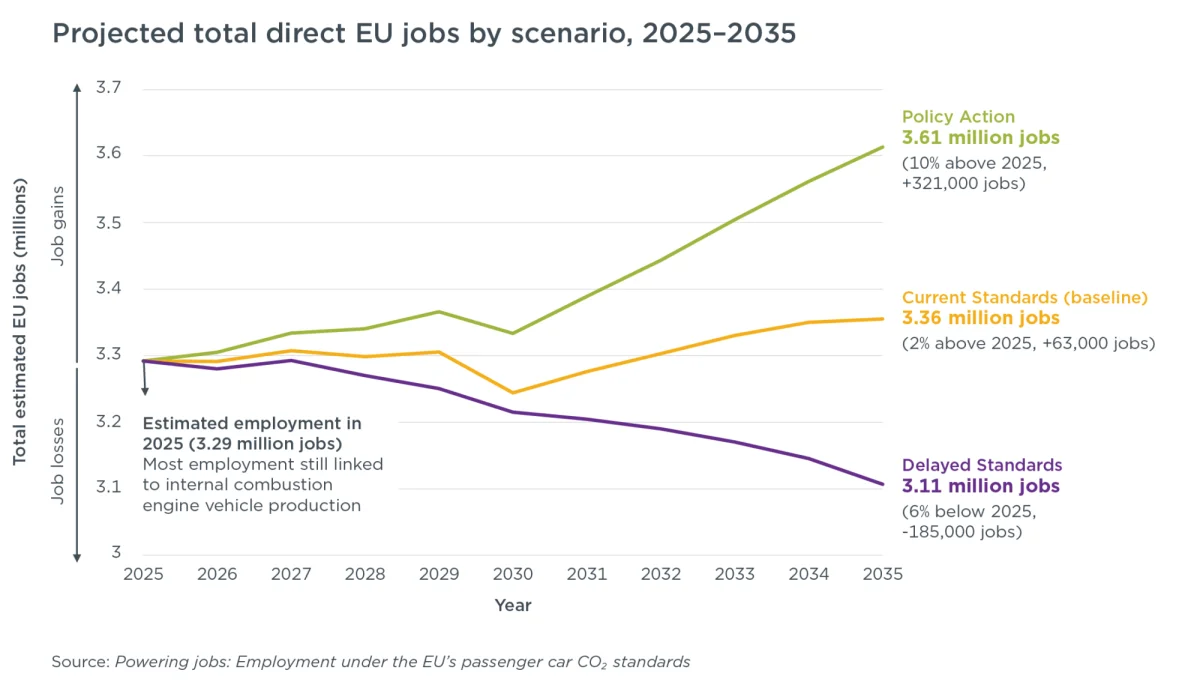
The employment effects of Europe’s car transition depend on more than whether combustion engine production holds on for longer. An analysis by the International Council on Clean Transportation (ICCT) finds that delaying the EU’s passenger car CO₂ standards could leave employment up to 185,000 jobs below 2025 levels by 2035. Keeping the current standards in place would leave employment broadly stable, while pairing them with measures to expand production in Europe could deliver a net increase of about 320,000 jobs.
Those figures reflect a shift in where work is expected to grow. A slower move to battery electric vehicles (BEVs) may temporarily support jobs tied to combustion engines, but it also slows employment growth in vehicle electrification: BEV and battery production, battery recycling, and the installation and maintenance of charging infrastructure. In the ICCT analysis, those emerging activities account for enough potential employment that holding back their expansion produces a net loss across the sectors included.
Three pathways, different employment outcomes
The study compares three scenarios through 2035. Its baseline follows the current CO₂ standards, adopted in June 2025. For new passenger cars, those standards require average tailpipe emissions to fall by 55% by 2030 compared with 2021, and set a 100% zero-emission sales target for 2035. The baseline also includes a fleet-averaging mechanism for 2025–2027.
A second scenario retains the 2030 and 2035 targets and assumes measures that increase the share of electric vehicle production taking place in the EU. The study represents these measures through broad assumptions about production, rather than estimating the effect of individual incentives or local production requirements. Under this pathway, employment rises by about 10% relative to 2025, or around 320,000 jobs, by 2035.
The third scenario assumes the standards are delayed by five years. Electrification proceeds more slowly: BEV and plug-in hybrid electric vehicle (PHEV) sales increase at a more moderate pace through 2030, and BEVs reach all new car sales in 2040 rather than 2035. The study estimates that employment could fall as much as 6% below 2025 levels by 2035, a loss of up to 185,000 jobs.
The difference between the production-support scenario and the delayed-standards scenario reaches about half a million jobs by 2035. Passenger car production accounts for the largest share of the gap. Battery production and recycling, along with charging infrastructure work, contribute an increasing share as the transition advances.
Timing and production location both matter
Near-term differences between the scenarios are modest through 2030. The employment gap grows more pronounced later in the period, as the pace of vehicle electrification shapes how quickly work expands in newer parts of the supply chain. The analysis therefore points to two connected factors: how quickly the vehicle market shifts to electric models, and how much of the associated production takes place within the EU.
Maintaining the existing standards is projected to keep employment within about 2% of its 2025 level in 2035. That result is not a claim that every part of the auto industry will retain its current workforce. The study’s central finding is about the combined employment across the activities it models: growth in electric vehicle related work can offset losses in combustion engine production. The production-support scenario adds another condition, by assuming that a larger portion of vehicle and battery output occurs in Europe.
That distinction matters for workers and businesses. A change in the sales mix can shift demand among manufacturing activities, while the location of production affects where those jobs are counted. The analysis suggests that slowing the transition may preserve some existing production for a time, but can also reduce the pace at which newer work develops. Its results frame the transition as a question of both industrial timing and production share, rather than a simple choice between preserving jobs and changing technology.
What the estimates include
The ICCT study isolates employment effects associated with vehicle electrification. It does not estimate the influence of automation, productivity, digitalization, manufacturing changes, global supply chains, geopolitical developments or broader economic conditions. It also excludes indirect and induced employment beyond its scope, including raw material extraction, retail and after-sales services. Workforce turnover, skills and training needs are not assessed.
These boundaries shape how the estimates should be read. The projected totals do not describe every job linked to cars, batteries or charging, and they do not show how employment may vary among regions or occupations. Nor do they settle how quickly companies can build production capacity in Europe. They compare broad employment outcomes under three modeled paths, with the production-support case depending on a higher European share of BEV and PHEV production.
The five-year delay is also a simplifying assumption. Changes to the standards could take other forms, such as extra compliance credits or averaging arrangements, and the study does not model each possible design separately. The results show the consequences of the scenario it tests, rather than a forecast for every form a change might take.
For the sector, the practical takeaway is that maintaining the 2030 and 2035 targets is associated with broadly stable employment in the model, while stronger European production adds potential for growth. The jobs outcome will depend on whether the expanding electric vehicle supply chain takes root in Europe as well as on the pace of electrification. Those two factors will shape how much of the transition’s new manufacturing and infrastructure work reaches European workers.