Weaker EU Car CO2 Rules Could Leave ETS2 Short by Nearly 4 Billion Allowances
Climate Science d.scott 797 reads
Looser EU road transport CO2 standards would push fuel demand past the fixed ETS2 allowance cap, with a projected deficit of nearly 4 billion allowances by 2050.
The EU's road transport climate plan depends on two policies pushing in the same direction, and one of them is now being asked to slacken. The Emissions Trading System will cover road fuels through a separate scheme, ETS2, from 2028. The CO2 standards for cars, vans, trucks and buses determine how much fuel those vehicles burn. Weaken the standards and the allowance supply stays where it is, so the numbers stop adding up.

How the two systems fit together
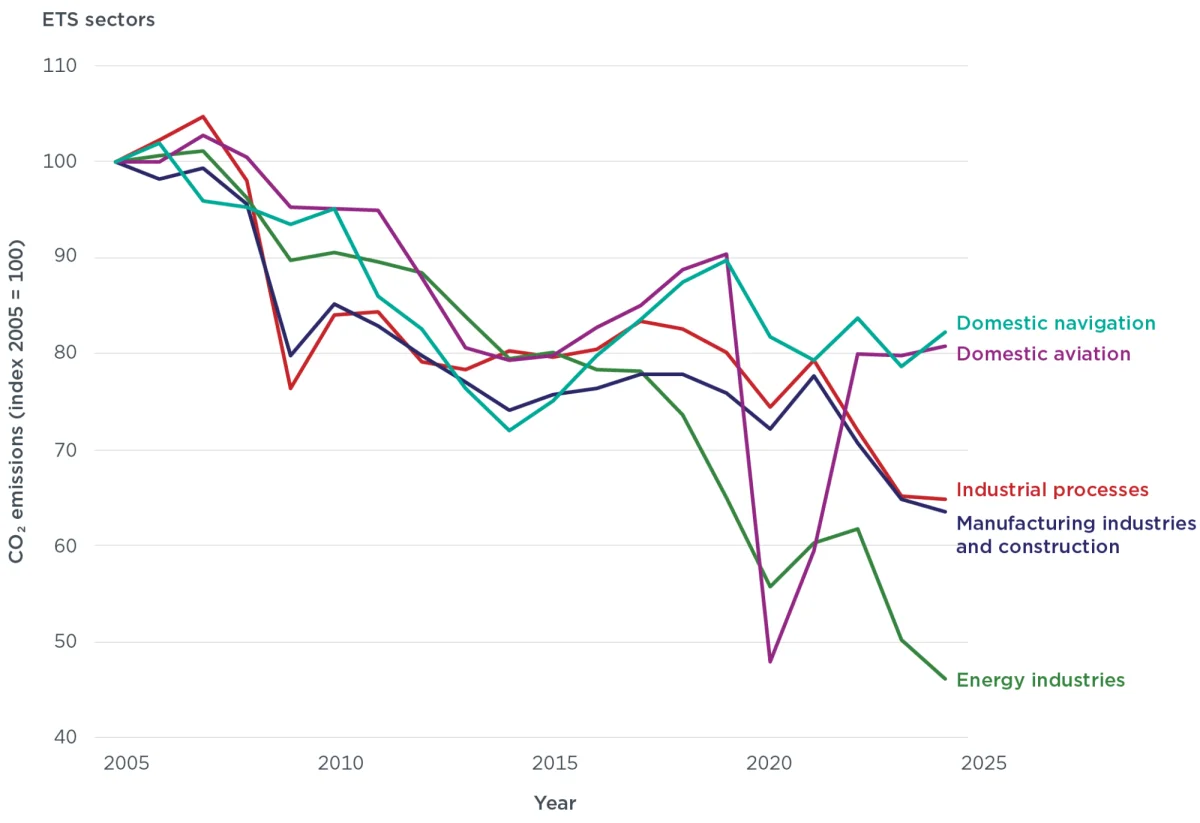
The ETS launched in 2005 as the world's first carbon market. Businesses buy an allowance at auction for every tonne of CO2 they emit, and the cap on those allowances shrinks each year. Under current rules, allowances run out around 2040. The original scheme covered power generation, heavy industry, and domestic navigation and aviation, and those sectors have cut emissions substantially since it began. In 2023, the EU extended the system to commercial and residential buildings and to road transport through ETS2.
The CO2 standards and the carbon market work as a pair. The standards push manufacturers toward zero-emission vehicles: under current rules, all new cars and vans must be zero-emission by 2035, and new trucks and buses must emit 90% less in 2040 than in 2019. The carbon price, meanwhile, makes fossil fuels more expensive, which narrows the cost gap for cleaner transport. One pushes supply of clean vehicles, the other pulls demand toward them.
What the December proposal changes
In December 2025, the European Commission proposed loosening the standards for both light-duty and heavy-duty vehicles. If adopted, the target for cars and vans would drop from 100% zero-emission by 2035 to 90%, alongside several other interim softenings. In heavy-duty vehicles, flexibilities in the amended rules effectively halve manufacturers' 2030 target, according to analysis from the International Council on Clean Transportation (ICCT).
The light-duty change alone is projected to add about 1 billion tonnes of CO2 cumulatively between now and 2050, compared with the current standards. The rapporteur steering the file on the European side is seeking changes that would add a further 2–3 billion tonnes on top of the Commission's proposal. Those figures show the direction of travel: the more the standards are diluted, the more emissions the road sector carries forward.
Where the allowance deficit comes from
This is where the policies collide. The number of ETS2 allowances is already fixed in regulation, so extra fuel demand has nowhere to go but into a shortfall. Between 2028 and 2050, the analysis estimates a deficit of nearly 4 billion allowances if the Commission's weaker rules are adopted.

Think of it as a bathtub with a fixed-size outlet. Fuel demand keeps pouring in, and the cap doesn't open any wider. The gap is the water that spills over.
Options for closing the gap
Alternative fuels are the first obvious lever. Biofuels and e-fuels that comply with the Renewable Energy Directive don't need allowances to be sold, and targets under the RED, ReFuelEU Aviation and FuelEU Maritime are expected to bring more of them to market. Even so, if these fuels had to close the whole gap alone, annual sales of RED-compliant fuel would need to peak at 4,200 PJ. Today's level is roughly 750 PJ, so that's more than a fivefold jump, and probably more than Europe could produce at home.
The Market Stability Reserve offers a second buffer. It exists to prevent sudden price spikes, and it can release up to 600 million allowances into ETS2 if prices climb too high. Emissions reductions in buildings, which could outpace those in road transport, might also free up spare allowances. Neither mechanism, though, looks large enough to erase a gap of nearly 4 billion.
The costs of closing the gap don't disappear, either. Fuel suppliers could buy extra RED-compliant fuel beyond mandated levels, but those fuels cost more to produce than fossil fuels and carry high indirect emissions from land-use change. They could also pay a penalty of €100 per tonne of CO2
The political variable
There's also a risk that the ETS2 itself gets weakened in its planned reviews over the next five years. That would compound the problem, because loosening the carbon market and the vehicle standards at once leaves the system with no slack anywhere. Weakening one component puts strain on the other. Weakening both leaves the transition without a backstop.
My read is that the allowance deficit is the number to watch in the coming rounds of negotiation. It translates an abstract debate about vehicle targets into a concrete question: how many tonnes of emissions will the road sector carry, and who pays for them? Keeping both the standards and the carbon market at full strength remains the most direct route to meeting the transport targets the EU has already set.