Stress Testing Sustainability Business Cases Makes Returns More Credible
Climate Science Daniel Aronson 657 reads
Testing key assumptions reveals how sustainability projects perform in a bad year, giving finance teams a clearer view of returns and risks.
For sustainability projects competing for tight budgets, a strong expected return may not be enough. Finance teams also need to know what happens when prices, costs or delivery assumptions move against the plan. Stress testing gives them that answer and helps project teams find weaknesses before a reviewer does.
The pressure is real. In a fourth-quarter 2026 survey of 131 CEOs by the Conference Board, 41 percent expected economic conditions to worsen, up from 19 percent in the previous quarter. CEO confidence had turned negative, and most respondents had no plans to increase capital spending. When funding is constrained, sustainability initiatives may face extra scrutiny: an EY survey in 2023 found 37 percent of finance leaders planned to reduce or pause environmental, social and governance spending within a year, even as they described it as a long-term priority. In a 2025 Kearney survey, 61 percent of 500 CFOs said they assessed sustainable investments through a cost-focused lens.
Uncertainty can weaken a sound case
Many sustainability projects depend on variables that can change: commodity prices, customer demand, the pace of adoption or the costs of implementation. A projected return may look compelling, but if its assumptions have not been tested, decision-makers can’t tell how much that return depends on a favorable set of conditions.
That uncertainty matters because people often prefer risks with known odds to situations where the odds are unclear. Research on investors and non-investors in the Netherlands, conducted by Wharton risk management professor Olivia Mitchell and colleagues, found that most participants were uncomfortable with ambiguity. Participants who perceived less ambiguity in an asset were more likely to invest in it. A business case with unexplored assumptions presents a similar problem: reviewers may see a claim they can’t confidently assess.
A useful case therefore needs to show how its financial result changes when key assumptions do. That analysis is frequently missing. In a review of sustainability business-case materials, Valutus collected 1,587 writeups published in 2025 and 2026, then selected 300 at random across six categories: academic research, consultancy articles, vendor and company cases, trade press, business school cases, and materials from nonprofit, public and industry organizations. Only about 8 percent included an assessment of what would happen if assumptions failed.
Six parts of a decision-ready case
A complete business case connects an action to a measurable financial result. It should identify who needs to achieve what, specify a project that can be approved and started, and calculate the net financial outcome by subtracting costs from benefits. It also needs to explain how the action produces that result, compare the proposal with alternatives—including continuing as usual—and test what happens when its assumptions are wrong.
That final step can be built into the analysis without making it unwieldy:
- Set out the base case and record each assumption, including prices, volumes, adoption, costs and timing. Note where each figure came from.
- Identify the assumptions that have the greatest effect on the result. Change them one at a time to see how much the outcome moves; often, only two or three drivers dominate.
- Run a pessimistic scenario by changing several important drivers at once. Choose values that describe a bad year, rather than an extreme outcome no one expects.
- Show the expected and pessimistic results side by side, with the assumptions behind each.
- Where suitable tools are available, use a Monte Carlo simulation. It can run thousands of versions of the model with assumptions varied together, revealing a range of possible results.
A recovery project tested across 2,000 scenarios
One example involved a large U.S. company with waste streams from dozens of sites. An analysis found copper, aluminum, steel and other valuable materials being sent to landfill. Recovering those materials offered two potential financial gains: lower disposal costs, because the amount landfilled could be cut in half, and revenue from selling the recovered metals.
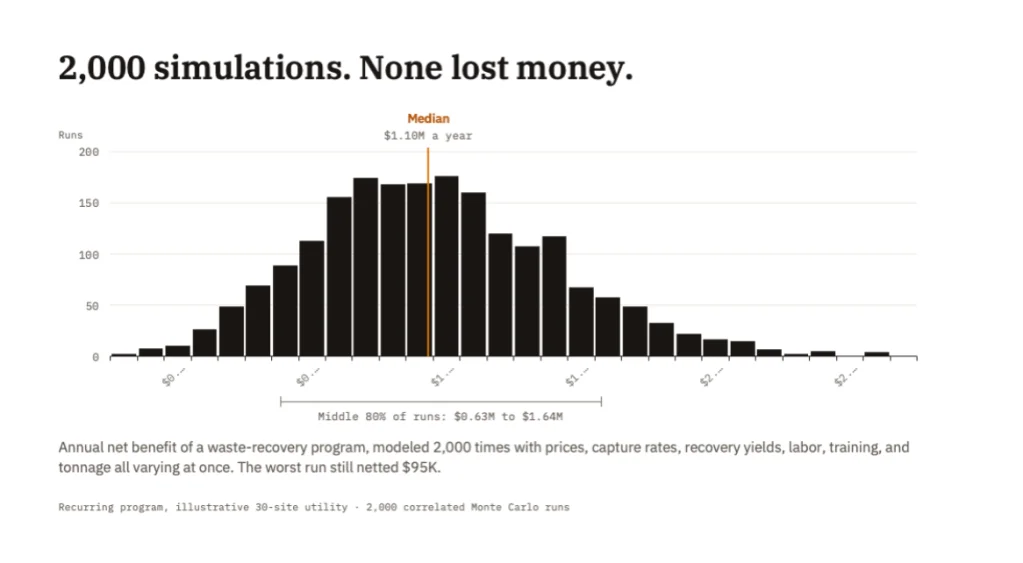
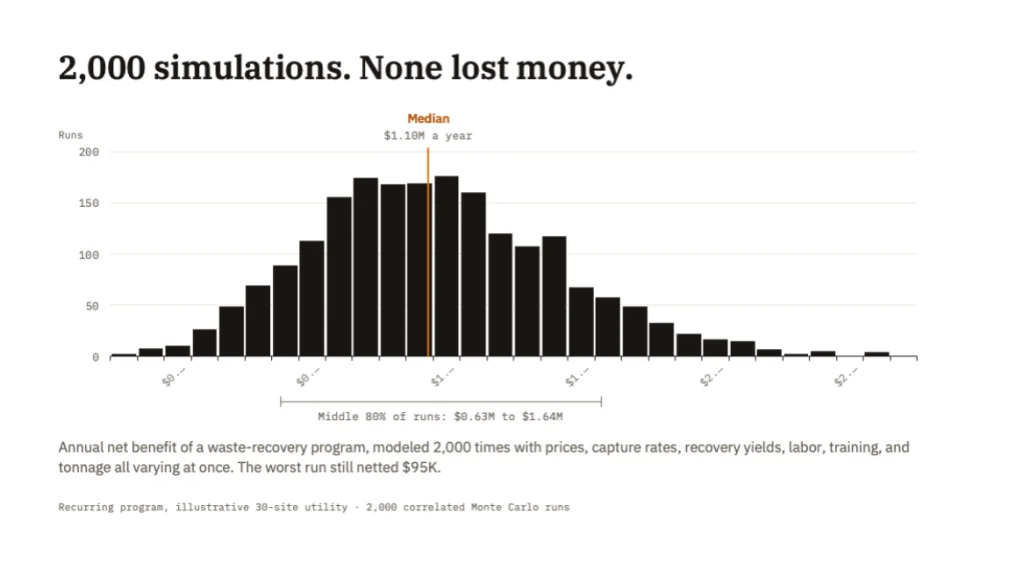
The projected benefit looked attractive, but the team tested how it would hold up as conditions changed. Across 2,000 model runs, it varied sale prices, material capture rates, recovery yields, labor costs, training needs and other factors. The exercise also included unusually steep changes in key variables. One copper-price decline in the model was comparable to only two declines of that severity since 1967.
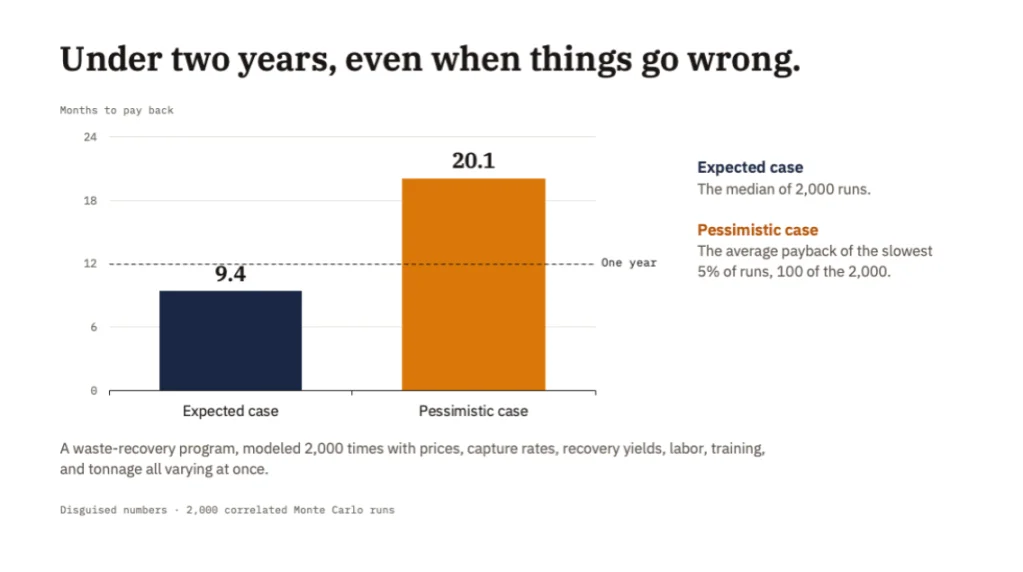
The median result across the scenarios was an annual benefit of $1.10 million, with payback in 9.4 months. The program lost money in none of the 2,000 runs. In the most pessimistic 5 percent of scenarios, average payback was 20.1 months—under two years.
Those results make the expected return easier to judge. “Payback is expected to be under a year” gives a reviewer a single forecast. Pairing it with the simulation results also shows how the project performs under difficult conditions. The second view is more informative because it makes the assumptions and the range of outcomes visible.
Turn the weakest assumption into an action
Stress testing helps a team spot the assumptions most likely to undermine its case and decide what to address. If the pessimistic scenario still produces a return, that resilience is part of the case. If it does not, the analysis shows which driver needs closer attention—perhaps material recovery, labor, timing or market price.
It also demonstrates that the sustainability team has considered where delivery could slip and how those changes would affect the result. This gives finance reviewers a clearer basis for judging the proposal and its practical risks. In a constrained budget cycle, the next sustainability case should answer a simple question upfront: if the numbers are wrong, how much does the outcome change?