Vietnam and Thailand Lead Rapid Growth in Electric Car Adoption
Climate Science d.scott 453 reads
Vietnam reached a 44% electric car share in early 2026, while fast growth in several newer markets is widening the geography of adoption.
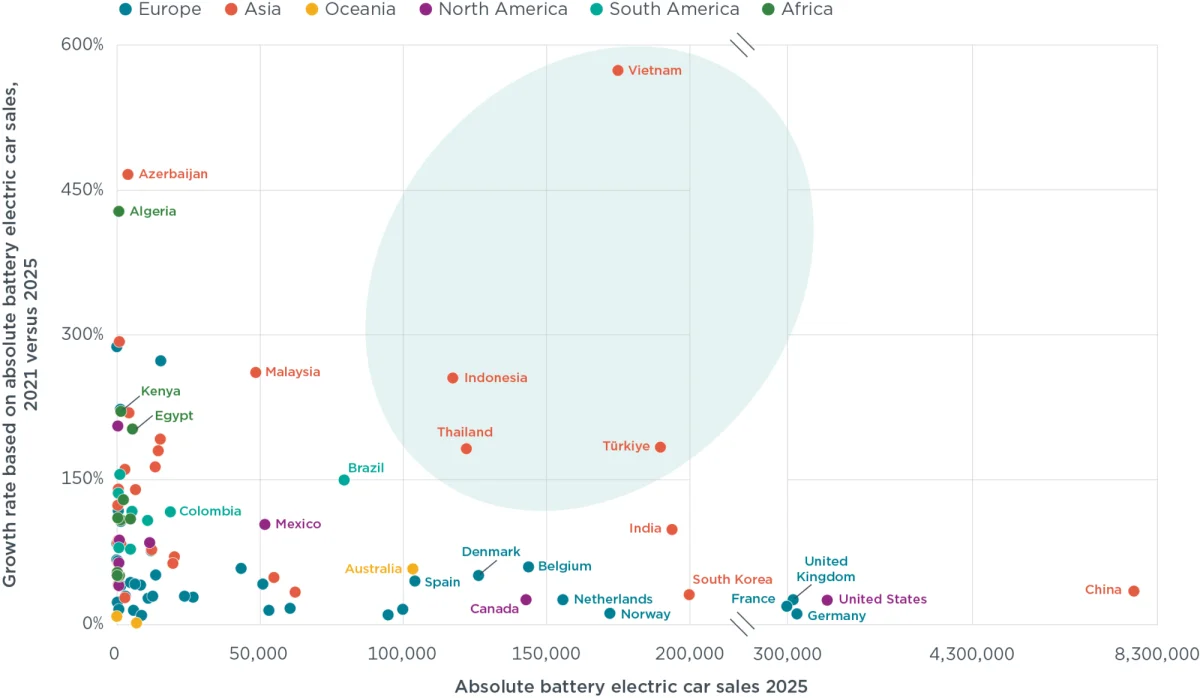
Electric car adoption is spreading beyond the markets long expected to lead it. Vietnam and Thailand reached some of the highest battery electric vehicle (BEV) shares in new passenger car sales in the first half of 2026, while Indonesia and Türkiye recorded rapid sales growth over the preceding four years. The shift broadens the transition’s reach, even as a handful of large markets continue to account for most electric car sales.
Southeast Asia moves up the rankings
Vietnam’s BEV share reached 44% in the first half of 2026: nearly one in every two new passenger cars sold was fully electric. Among 55 markets with data for both BEV sales and total new passenger car sales, Vietnam ranked fifth. Thailand ranked eighth, with a 41% share. Indonesia ranked 22nd at 21%, and Colombia was 26th at 16%.

Those figures describe the mix of new sales, not the share of all cars on the road. That distinction matters for households and businesses weighing how quickly electric vehicles may become familiar options in a market. A high share of new sales can signal a fast change in what buyers can choose, while the existing vehicle fleet turns over more gradually.

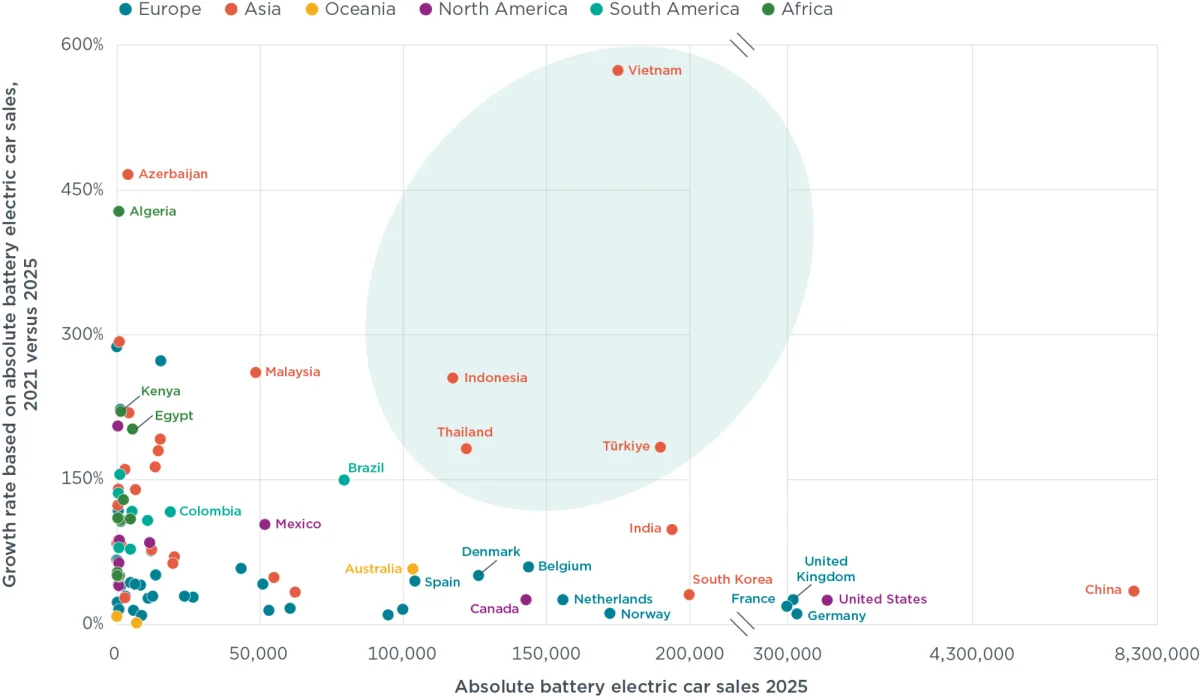
Sales growth over a longer period points in the same direction. Among countries with at least 100,000 new BEV sales in 2025, Vietnam recorded a compound annual growth rate of 574% from 2021 to 2025. Indonesia’s rate was 255%; Türkiye’s was 183%, and Thailand’s was 181%. These growth rates compare sales in 2025 with the smaller starting levels in 2021, so they show the pace of expansion rather than the countries’ relative sales volumes.

More models and local industry help shape uptake
The expansion in Vietnam, Indonesia, Türkiye and Thailand has been associated with BEV incentives, a wider choice of models, and efforts to build local supply chains and attract investment. Domestic manufacturers contribute in different ways. In Vietnam, VinFast accounts for almost all new BEV sales, making the country’s uptake closely tied to one manufacturer. Türkiye’s domestic brand Togg has also supported growth, alongside a broader group of manufacturers.

That mix suggests why adoption can accelerate in markets that once seemed likely to follow later. When more models reach buyers and local manufacturers take a substantial role, consumers and businesses have more ways to consider an electric car. The figures alone do not identify how much each factor contributed, however, and they do not show whether the pace of growth will continue.
Fast growth also has practical implications beyond the showroom. A rising flow of electric cars increases the importance of charging access for homes, workplaces and public destinations. It can also create new demands on the businesses that sell, service and supply vehicles. The sales figures provide a measure of market uptake, but do not establish how charging networks, repair capacity or ownership costs compare between countries.
Established leaders remain ahead in market share
High adoption in newer markets is happening alongside continued leadership elsewhere. Norway recorded a 98% BEV share of new passenger car sales in the first half of 2026, Denmark 80%, and Singapore 60%. Their sustained high shares reflect years of support for adoption, including fiscal incentives, tax systems that favor BEVs and continued investment in charging infrastructure.
These examples show that growth and a high market share are different measures of progress. Vietnam’s 44% share is striking, while Norway’s 98% shows what a market can reach after a longer period of widespread adoption. The figures do not establish that all countries can follow the same route: the conditions behind adoption, including model availability, tax treatment and charging access, vary by market.
Large markets still account for most sales
By sales volume, the biggest passenger car markets remain central to the global transition. China recorded almost 3 million new BEV sales in the first half of 2026. The United States followed with 452,000, then Germany with 368,000, the United Kingdom with 285,000 and France with 242,000. Together, those five markets represented 68% of new BEV sales worldwide during the period.
Their shares of new passenger car sales varied widely. China reached 35%; France, 28%; Germany, 26%; and the United Kingdom, 25%. The United States stood at 6%. A market can therefore have a large effect on global totals because it sells many vehicles, even when its BEV share is comparatively low. Conversely, a smaller market can post a high share without contributing a similar volume of sales.
The figures draw on data from EV Volumes, Dataforce, Gasgoo, Segment Y, TAIA, ODMD, ANDEMOS, FENABRAVE, ANAC, VAMA, Hyundai and GAIKINDO. Passenger car definitions differ among markets and data providers; some include certain light-duty vehicles, such as pickup trucks, while others classify them separately. That limits direct comparisons at the margins.
The clearest signal is a widening geography of growth: several markets outside the traditional leaders are now adopting BEVs quickly, while China and other large markets still dominate sales totals. Watching whether model choice, charging access and local supply chains keep pace will help show how durable that expansion is.