First Solar Opens South Carolina Solar Module Plant, With Capacity Set to Double
Climate Science Martin McConnell 687 reads
First Solar has started production in Gaffney. A second phase due by mid-2027 is expected to lift the plant’s annual capacity to 3.4 GW.
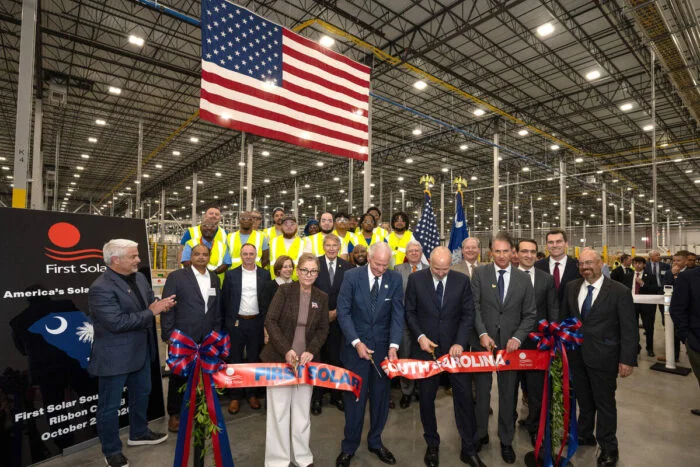
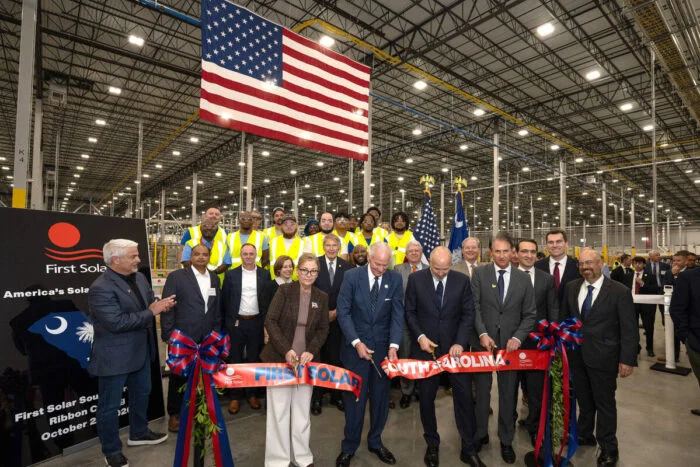
First Solar has begun production at the first phase of its manufacturing facility in Gaffney, South Carolina, bringing final assembly of its Series 6 Plus solar modules onto U.S. soil. The plant’s planned second phase would double its annual nameplate capacity to 3.4 gigawatts, giving the company more domestic manufacturing room as electricity demand grows.
The first phase was inaugurated on Oct. 28, less than a year after First Solar selected Gaffney for the project. The company says its international manufacturing network will make the modules before the finishing processes take place at the South Carolina site. That arrangement puts final production closer to U.S. customers and could help limit exposure to shipping tariffs and concerns tied to foreign-entity-of-concern rules.
For solar buyers and developers, the location and production sequence matter because supply chains shape both delivery timing and the origin of components. First Solar says its modules do not depend on Chinese crystalline silicon supply chains. The company uses its own thin-film technology, rather than the crystalline silicon approach common across much of the solar module industry. That distinction gives buyers another manufacturing pathway, while the new facility adds U.S. finishing capacity to the company’s existing production network.
Hiring and the next construction phase
The two-phase project is expected to support 700 jobs when fully operational. First Solar says it has already hired about 500 people for the facility. Those positions connect the expansion to the local labor market in Gaffney, though the available figures do not break down roles by production, maintenance, logistics or other functions.
Completion of the second phase is planned for mid-2027. The company puts the full project cost at about $330 million. Once both phases are operating, annual nameplate capacity is expected to reach 3.4 GW. Nameplate capacity describes the facility’s designed production potential; actual output can vary with operating schedules, equipment performance and demand. The expansion therefore marks a substantial increase in production capability, while the full scale of manufacturing will depend on how the site runs after completion.
That timing also gives the company a staged ramp-up: production is starting while the next phase remains under development. For customers, additional capacity can broaden the pool of domestically made modules available for projects. The practical effect will depend on production volumes, delivery schedules and how the plant’s output fits into First Solar’s wider manufacturing system.
A larger domestic manufacturing footprint
First Solar links the Gaffney investment to rising demand for domestically produced energy technology following enactment of the One Big Beautiful Bill Act in July 2025. The company’s expansion sits within a broader effort to increase U.S. solar manufacturing, although the facility’s contribution should be measured against production actually achieved rather than its nameplate figure alone.
By the end of 2026, First Solar expects to have invested more than $5 billion in U.S. solar manufacturing and research and development infrastructure since 2019. It also forecasts about 17 GW of U.S.-based module manufacturing capacity by 2027. Those figures describe company investment and anticipated capacity across its domestic operations; they are not measures of annual output from the Gaffney plant alone.
First Solar chief executive Mark Widmar said the facility was ready to produce solar technology with a South Carolina workforce, and connected the investment to customer demand for dependable supply as U.S. electricity needs rise. His comments point to the company’s central case for the plant: manufacturing location and supply-chain sourcing can be part of the value customers consider alongside module performance, price and delivery.
The next measures to watch are the second phase’s progress toward mid-2027, the pace of hiring toward the projected 700 jobs, and how closely realized production approaches the site’s 3.4 GW annual design capacity. Those outcomes will show how quickly the new facility turns its planned scale into a steady source of modules for U.S. solar projects.