Germany's Company Car Fleets May Be Closer to EU EV Targets Than Critics Admit
Climate Science d.scott 580 reads
French company fleets already sit near the EU's proposed 2030 battery-electric share, suggesting Germany's corporate car market could get there too.
Germany looks like the obvious place for the EU's Clean Corporate Vehicles Regulation (CCVR) to succeed. The country is the EU's largest passenger car market and its biggest producer of battery electric vehicles (BEVs). Around two-thirds of new passenger car registrations are made by companies rather than private households. Yet the proposal, which aims to speed up electrification of company vehicles, has drawn sharp resistance in Berlin and among industry players. My read is that much of that pushback rests on a misreading of what the regulation actually requires, and that the evidence from elsewhere in Europe points the other way.

What the regulation actually asks for
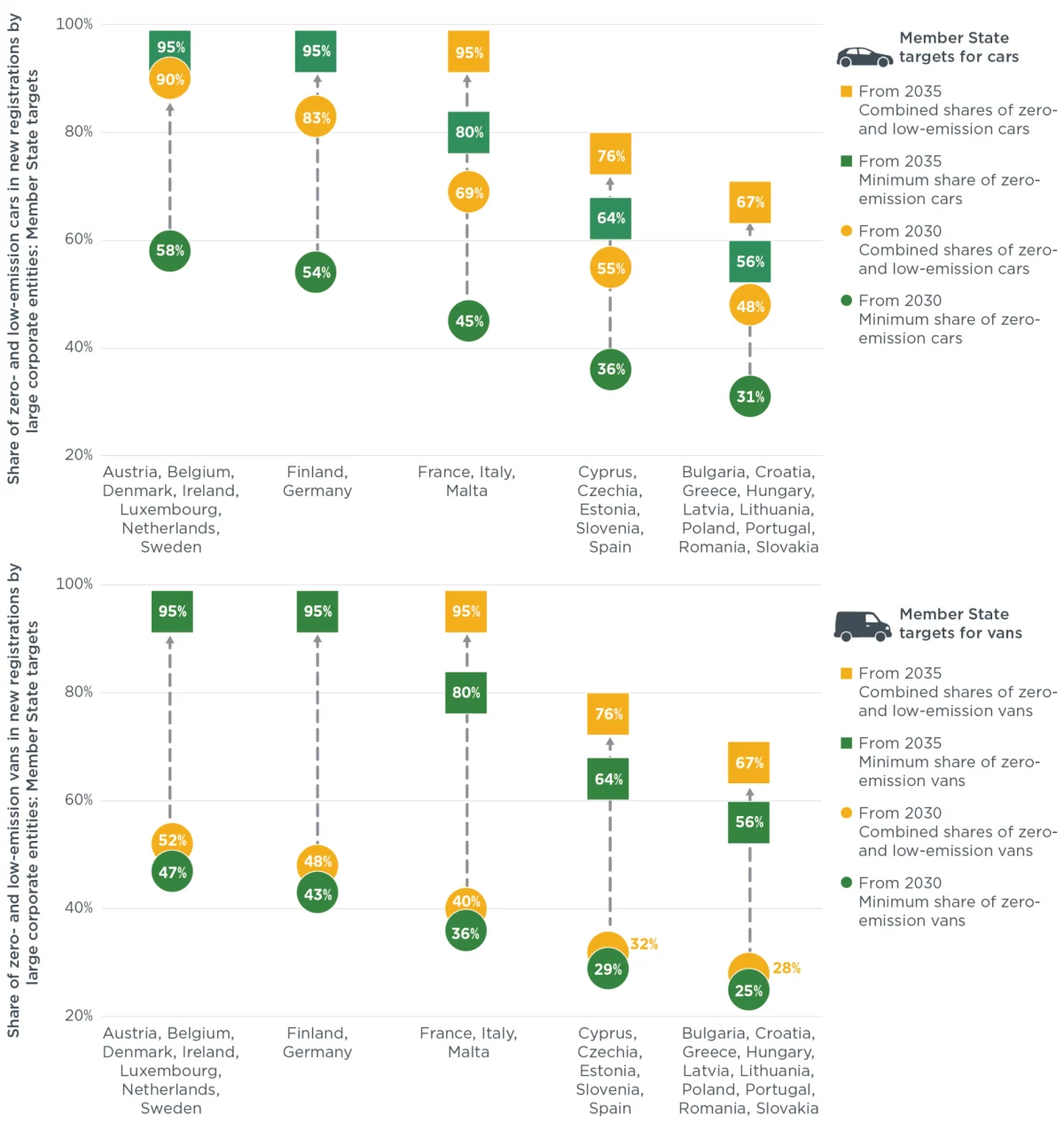
The most common misunderstanding is that the CCVR sets sales quotas for individual companies. It doesn't. The wording refers to "minimum targets… in yearly new registrations of corporate cars by large undertakings," which invites that reading. In practice, each Member State is measured on the share of zero-emission vehicles, and on the combined share of BEVs and lower-emitting plug-in hybrids, in new registrations by large companies. Targets are set separately for cars and vans.
The definitions matter here. A "corporate vehicle" is one registered by a legal entity rather than a private person. The targets focus on "large undertakings," meaning companies that meet at least two of three thresholds: 250 employees, a €25 million balance sheet total, or €50 million in net turnover. The regulation also leaves the tools to national governments, from vehicle taxation and incentives to procurement rules and charging roll-out.
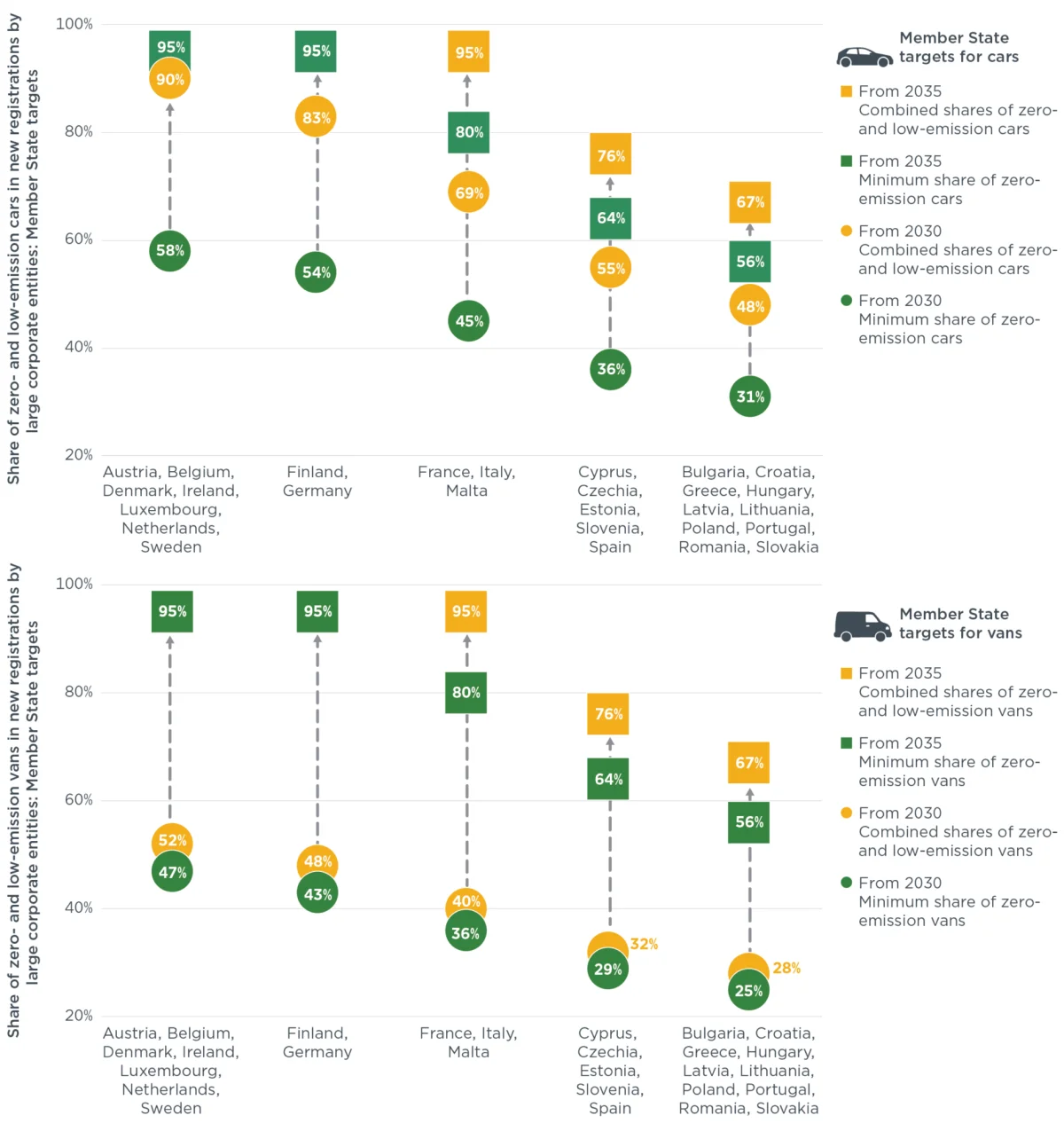

Source: ICCT visualization based on the CCVR proposal.
France as a working benchmark
Germany doesn't publish company registrations broken down by employee count, which makes it hard to say how far German firms are from the proposed targets. France is a useful stand-in. It is the EU's other large passenger car market and sits at a similar stage of BEV adoption, and its registration data are split by company size.
The numbers are telling. In the first eight months of 2026, BEVs made up 43% of new passenger car registrations among French companies with at least 250 employees. That is just two percentage points short of the 45% battery-electric share the CCVR targets for large undertakings in 2030.

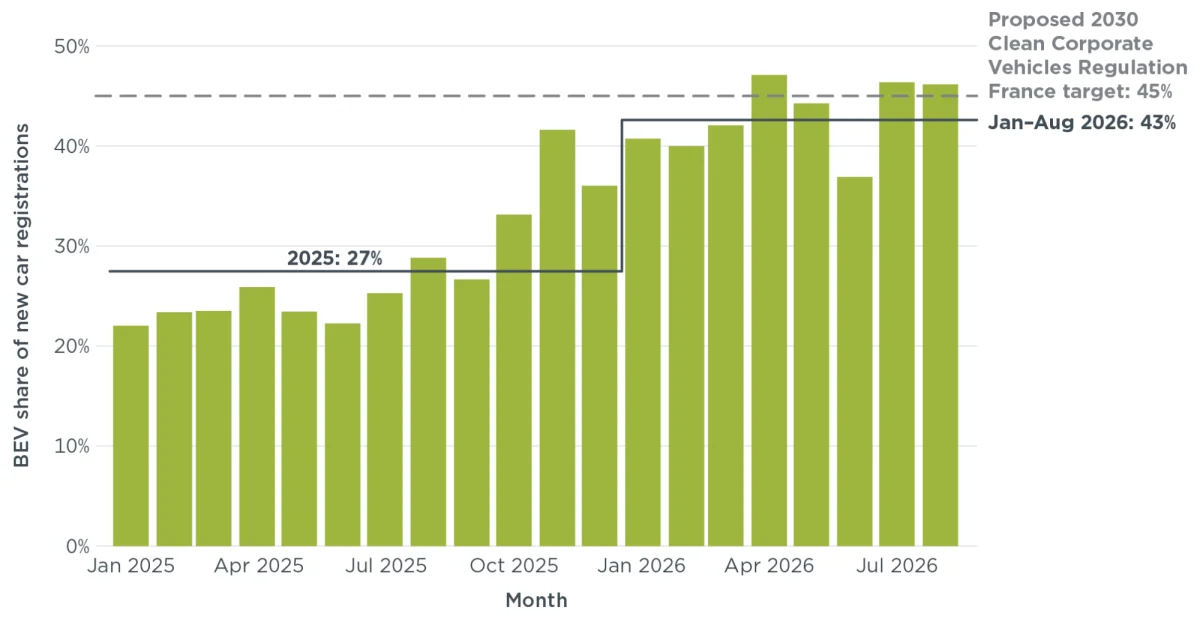
Source: C-Ways; Système d'Immatriculation des Véhicules (SIV)
Size makes a big difference. Among French companies with 1,000 or more employees, BEVs already accounted for at least 46% of new registrations in the same period. For those with 5,000 or more, the share topped 56%. The transition is clearly underway. The open question is pace, and the companies that lag are mostly the 250-to-999-employee group, which still made up 51% of new company BEV registrations.

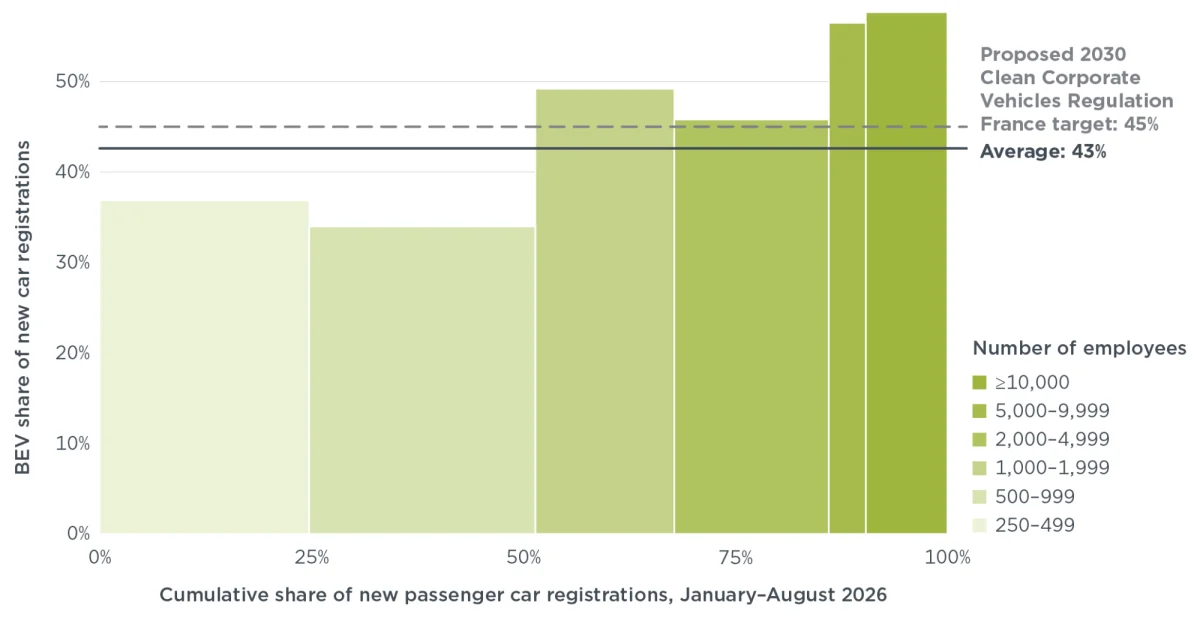
Source: C-Ways; Système d'Immatriculation des Véhicules (SIV)
Where adoption stalls, and why that matters
Uptake also varies by company type. Manufacturers, public entities, and dealer and rental services have adopted BEVs more slowly. The remaining company types, which accounted for two-thirds of cumulative registrations from January to August 2026, saw one in every two new cars registered as a BEV. That pattern suggests the barriers differ by sector rather than reflecting a general inability to electrify fleets. Here's the thing: that argues for targeted measures aimed at specific obstacles, not for dropping the regulation altogether.
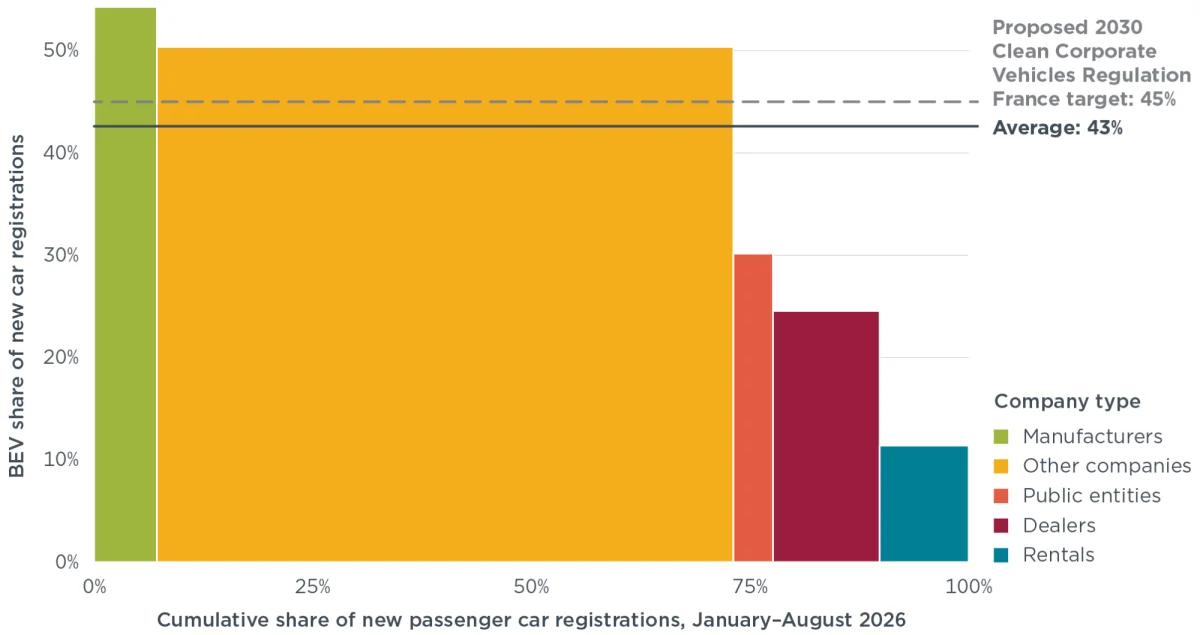
Source: C-Ways; Système d'Immatriculation des Véhicules (SIV)
Demand-side policy alongside the CO2 standards
A common objection is that the CCVR piles extra burden on top of existing EU rules, especially the vehicle CO2 standards. Those rules and the CCVR work on different sides of the market, though. The CO2 standards are largely supply-side. They push manufacturers to sell more BEVs by capping the average emissions of their new fleets. The CCVR is mainly demand-side. It aims to create more predictable BEV demand from large corporate buyers.
That predictability is the real value for automakers. Without enough demand, manufacturers face more risk when committing money to electrification, battery supply chains and production capacity. A deeper corporate BEV market could close that gap. The proposal also includes an industrial angle: Article 4 would limit financial support to vehicles "made in the EU," although the detailed definition is still being negotiated. If that holds, growing corporate demand would feed directly into EU vehicle production.
There's a secondhand effect as well. Company cars typically reach the used market much sooner than privately owned vehicles. Faster fleet electrification would therefore put more used BEVs into circulation, reaching buyers who couldn't afford a new electric car.
What this means for Germany
Company buyers are a decisive market for Germany's passenger car industry and its supplier base. Strengthening BEV demand from that segment now could also protect the industry's competitiveness as the global shift to electric vehicles accelerates. That said, the French data show that the largest fleets are moving first and the mid-sized ones need help. Germany's policy debate would be more productive if it focused on how to bring those mid-sized fleets along, rather than on whether the target is reachable at all.